Wednesday, June 7, 2017

8 DIY SEO Tips to Optimize Your Mobile Marketing

Mobile SEO is the single most important marketing factor for the typical local business.

8 DIY SEO Tips to Optimize Your Mobile Marketing


Mobile online marketing is now synonymous with online marketing. More users consistently use mobile devices today than connected ones. In late 2016, Google began testing a mobile-first index. When they rollout and begin using the index, search engines will look to the mobile version of your website before the desktop version to determine ranking.
Websites without a mobile version or with a poorly optimized mobile website will slip even further in search engine results pages (SERPs) as the rollout encompasses more sites. The good news is that some mobile SEO tasks are very easy to do yourself.
If your content performs inconsistently across mediums, you’re missing an audience engagement opportunity. Mobile SEO, much like traditional SEO, is about creating and tagging content in a way that makes it stand out online. Use this list of DIY mobile SEO tips to protect your brand from search engine penalties and maintain online visibility:

1. Create a Google My Business listing.

One of the most important listings businesses owners can create, Google My Business accounts are free and simple to set up. Fill out the information to the best of your ability, and include as many images of your business as possible. When people enter a search for your business online or via a Google app, they will likely see this information first. Make it count.
Related: How to Set Up 'Google My Business' for Your Small Business

2. Frequently review all directory listings.

Beyond the Google My Business account, mobile users may use other websites and applications to find your brand. Frequently review and update all listings for your business online. Update listings on Yelp, local websites, TripAdvisor, Facebook, Angie’s List, the Better Business Bureau and other popular business directories. These listings will ensure searchers reach the right information when they search for your name.
Related: 7 DIY SEO Tactics for Companies Not Ready to Hire a Consultant

3. Get social.

On mobile devices, social media sites drive a significant amount of traffic. Around 80% of social media users spend their social media time on mobile devices. If you want to maintain visibility with mobile users, prioritize your social media marketing strategy. Use platform-specific advertising, engage with users, and/or post prolifically to ensure your brand stands out.
Related: Is Amazon's 'Merch' the Next Big Thing?

4. Take advantage of plugins.

If your business uses WordPress or another platform, take advantage of the plugins designed to make your mobile site more user friendly. WordPress offers plugins to improve site speed, optimize images, and take care of other important mobile SEO tasks. WPtouch is a somewhat ubiquitous WordPress plugin that will create a Google-approved mobile-friendly version of your website. If you’re not currently using a professional to update and optimize your website, look into how plugins can help you maintain visibility online.
Related: 20 Crucial WordPress Plugins

5. Use keywords for content visibility.

Mobile users search differently than desktop users. Optimize for mobile keyword searches to keep your content in front of the right people. While you can purchase tools to find the right keywords for your content, you can find keyword comparisons by device in Google’s Search Analytics.
Related: 3 Tools to Uncover Your Competitor's Keywords

6. Optimize images.

To improve page loading times on mobile devices, optimize images for mobile users. If you don’t use a plugin to help with images, identify the ones that present a problem using a page speed tool and then compress or change the dimensions for faster loading times.
Related: 5 Ways to Optimize Your Ecommerce Campaigns

7. Prepare your content for mobile.

In addition to searching differently on a mobile device, many people digest content differently. Readable and scan-friendly content tends to work better on mobile devices, but testing is the only way to know for sure. Consider using a basic A/B test format to determine which types of mobile content perform better.
Related: So, What's the 'X-Factor' in the A/B Testing Formula? (Infographic)

8. Optimize for local searches.

You may not want to dive into detailed code optimizations that can boost search rankings, but you may want to consider a few basic activities. To optimize for local searches, include both the city and state in title tags, the URL, the H1 heading, and Meta description.
Mobile SEO will soon trump desktop SEO. Consider working with a professional or attempting a DIY head start today to ensure your site maintains visibility in mobile and desktop searches. A few simple tweaks can boost your digital presence and bring local customers to your door.

Reference: https://www.entrepreneur.com/article/295328

Tuesday, June 6, 2017

Why Unlimited Web Hosting Services are Good for SEO


Why Unlimited Web Hosting Services are Good for SEO
Personally I never thought web hosting services really had impact in any business. All it summed up to was more money for the host. If you share the same school of thought you’re probably right especially if you haven’t seen clouding services. On my side I’ll take my sentiments back. What experience has taught me is the truth. Web hosting for SEO and cloud based services is really important. In reality it has more benefits to the business than anyone would imagine. Here are some of the most factual benefits it provides.
It keeps your links checked. Dead links deny your website the juice it deserves. Additionally it leads to high bounce rates and minimal conversions. At the end of it this leads to losses. When you have a web host this is often minimized. The reason is simple. Part of the host’s job is to keep an eye on your links and to update them every time they die. This keeps your website very active. At the end of it all your website will have minimal or no dead links at all and that cool.
It’s good for optimization. Today many prospective buyers own a Smartphone, tablet, or a browser. The best websites should be able to provide all the prospective visitors with a smooth ride irrespective of their choice of gadget. Such optimization is crucial in case you want a smooth flow of business. Expert web hosting services often cover for this kind of integrate-able optimization.
It is extremely convenient. The best web hosting services just don’t end with a single service, no! Actually there are often a variety of services provided including content creating, website design, and many more. Having all these services under one host is extremely convenient. You don’t have to waste so much time looking for independent services, money hiring new employees to do the job, and energy that over works your limited staff. That’s why hosting for SEO is ideal.
It’s also very much targeted. Imagine this, having a single platform whose main intention is to rank you? What this means is that every service they provide is intended to give your top notch visibility. These services are therefore targeted and will include downsizing the number of HTTP requests, minimizing load time to Google standards, developing ideal CSS, and many more.
It cuts down overall costs. Web hosting can be a shared affair. If shared, you’ll share the overall costs too. This would mean cutting costs. Additionally have an independent server means hiring techs to service and maintain it, web hosts provide those services within their package. At the end of the day you don’t have to hire such services. In overall you will minimize your costs.
It offers vital backups. If your server crashes it’s an obvious disaster. When hosted you don’t lose everything as these services involve routine backups. These routine backups ensure that you get back everything that you had worked for. It is therefore more reliable than having a personal system.

Conclusion

There is no doubt that hosting for SEO is very beneficial. For startup it is an assured security path too. In addition to all these it is also very affordable and extremely viable for cutting costs.
Make sure you find the best services. These should be provided by highly experienced experts. The experts should be trained professionals with the knowledge of the most vital business needs.


Reference: https://thenextweb.com/contributors/2017/06/05/unlimited-web-hosting-services-good-seo/#.tnw_nQYlxwQo

Monday, June 5, 2017

How to Deal With Competitors Targeting Your Brand Terms

How to Deal With Competitors Targeting Your Brand Terms 
 
A little bit of healthy competition won’t hurt anyone, right?
Well, that’s not always true. When it comes to branded bidding wars on Google paid search, things can turn real nasty.
Imagine the scene. You wake up one morning, search for your company’s brand name in Google, and discover your competitor has stolen the number 1 position in paid search and is gobbling up a large percentage of your traffic.
This is no ordinary traffic either. This is highly valuable traffic — they’re your best potential (or existing) customers.
For most brands, this would cause instant chaos, especially if your brand terms are searched for in large volumes. So, what next? Surely if you report this PPC shark to Google, they will take immediate action and remove their listing, right?
Think again.
Google lifted the ban on bidding on competitors’ branded keywords way back in 2008, and since then it’s been completely acceptable to bid against your competitor’s brand, as long as you don’t mention their trademark name within your ad copy. It’s a bit of a gray area, but completely fair in Google’s eyes.
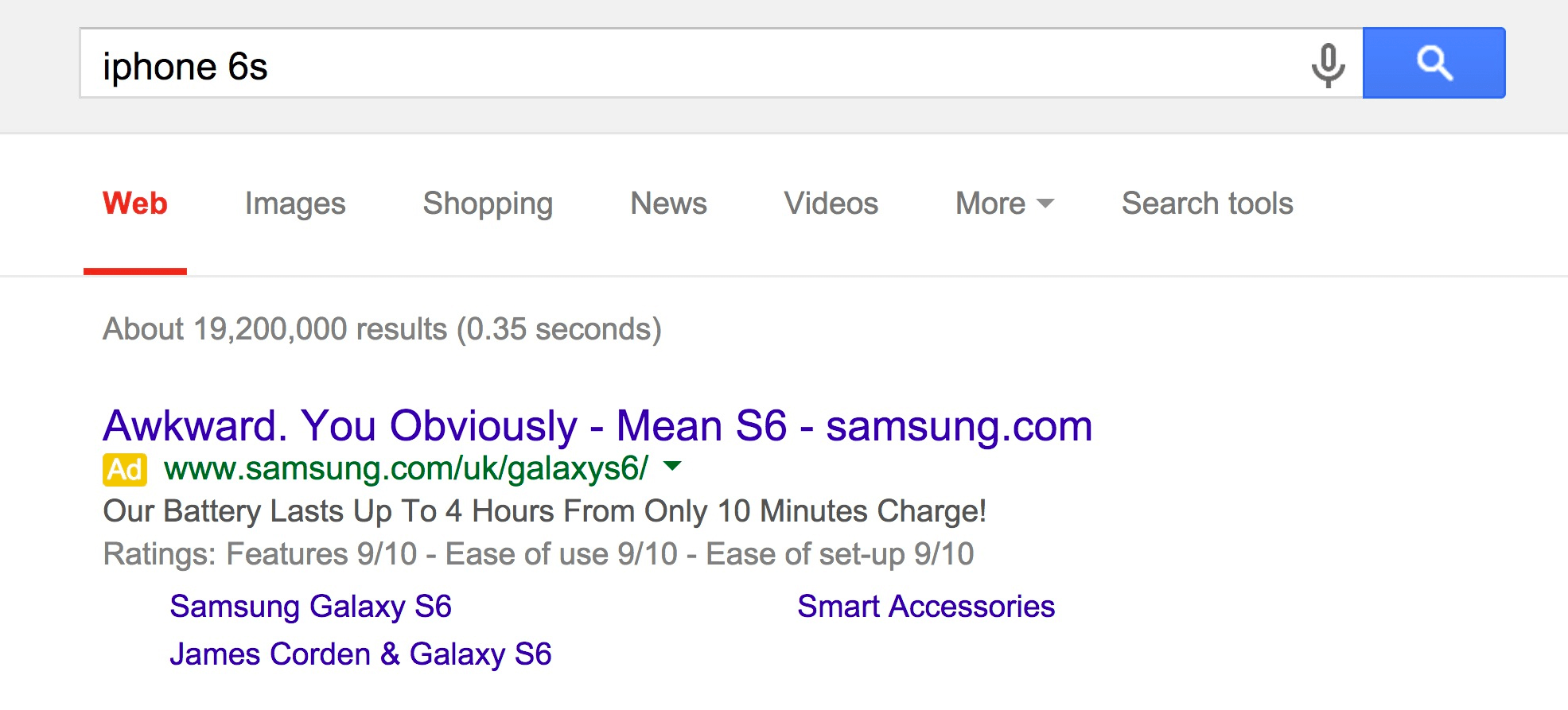
Many of us will already know about Samsung’s famous ‘Awkward. You obviously mean’ Google AdWords campaign targeting Apple’s precious iPhone 6s branded terms.
And I have to admit, this is creatively genius. It sparked plenty of media attention and the traffic was highly valuable. But I can guarantee Apple didn’t look at this in the same light.
Samsung targeting Apple on Google Adwords
In such a scenario, what would the best course of action?

Step 1: Acknowledge That Your Competitor May Never Take Down the Listing

It’s a tough blow to accept, but your competitor is under no legal obligation to remove their ads as long as they aren’t using your brand name in their ad text.
You have to come to terms with the fact that they will never remove the ads. The results may just be really powerful for them, leading to a high ROI/ROAS which could potentially be their most profitable campaign of all.
If they’re using your trademark name in their ad copy, however, this can be an infringement of Google’s trademark policy and therefore, you can submit a request to Google have their ads removed.

Step 2: Check Google Search Partners

Google isn’t the only search engine you should monitor for branded PPC. Its search partners could potentially be driving your competitors a lot of traffic.
Unfortunately, Google doesn’t disclose a list of its search partners as its network is growing and they are subject to change at any point. That said, some of the most popular search partners are AOL.com, Ask.com, Dogpile.com, and Amazon.com.
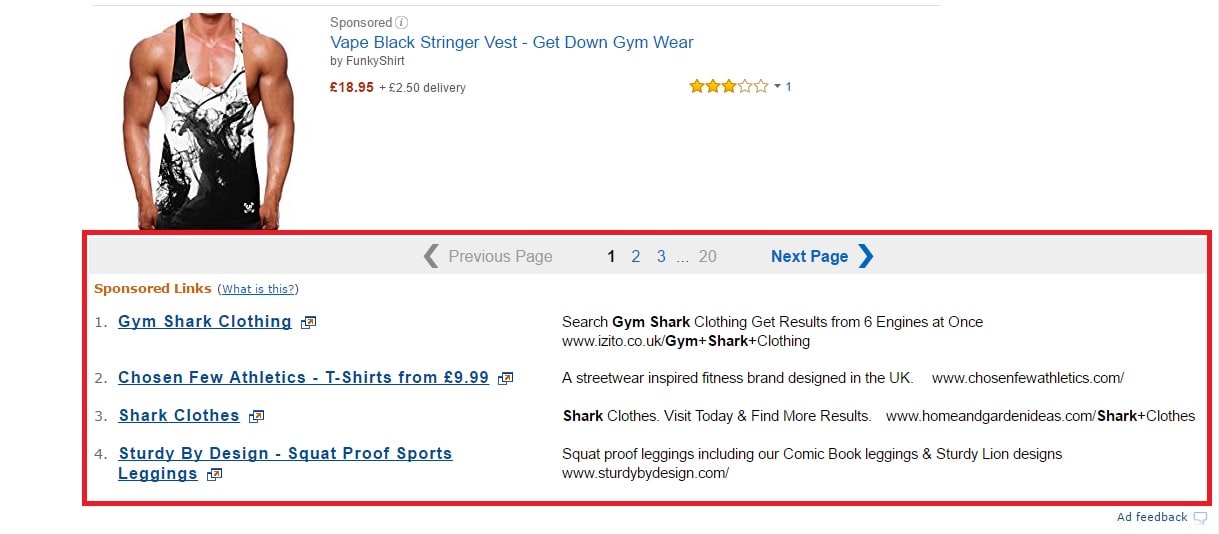
Here’s an example of how the ads would appear on Amazon. For this example, I searched for “Gym Shark”, which is a popular sports and activewear brand based in the UK.
Gym Shark Google search ads
If you’d like to dig a bit further to uncover more search partners, a list can be found here, albeit they may not be 100% accurate.

Step 3: Check Bing and Its Search Partners

For sure, Google is by far the most dominant search engine, but don’t underestimate the power of Bing and its search partners to drive highly relevant, targeted traffic. This is not always true for unbranded search because CPCs tend to be lower, but conversion rates aren’t always as high as the Google search network.
For branded search, however, you may just uncover a heap of new customers you never knew existed.
If your competitors are going full throttle stealing your most prestigious web traffic, chances are they’re taking advantage of Bing and its search partners, too — particularly Yahoo. So keep your eyes peeled.
Download Your Competitors SEO & PPC Campaigns
Get instant access to competitive insight that will help you increase your traffic and increase profit. SpyFu is free to try. No CC required.

Step 4: Send Your Competitor a Polite Email Request

Think twice before going all out guns blazing, picking up the phone for a good old argument with your competitor.
Chances are, this will only make matters worse and they will be even more determined to conquer your branded search traffic. This could potentially have a serious impact on your bottom line, particularly if your USP is difficult to distinguish or your competitor has incentives in place to steal away your customers.
The best course of action is to send a polite email to your competitor asking them to take down the ad, in the interest of fair play. You can certainly send a word of warning later about your plans to take PPC revenge, but you should first give them an opportunity to remove the ads.
It could be the case that their PPC agency has set up these ads without permission or any prior notice. (This isn’t a good agency practice, but it’s been known to happen.)

Step 5: Set Up Your Own Branded Search Ads

Whoa, you mean to say you haven’t already done this?
Branded PPC ads are an absolute must. This is especially true if you wholesale products to other retailers.
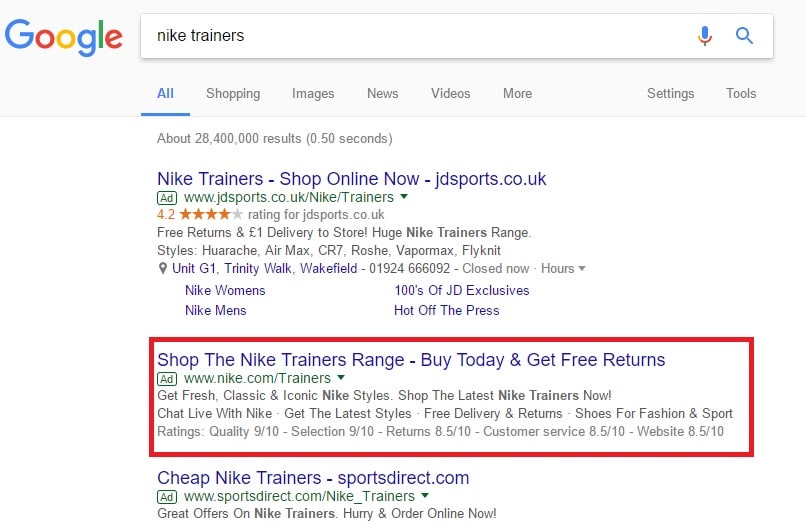
Take Nike, for example:
Nike Google Ads
But why would brands such as Nike bid on their own branded keywords if they’re already ranking highly organically?
Simply put, this allows brands to dominate the SERPs. Having multiple listings in Google (both paid and organic) can drastically improve your click-through rates and micro and macro conversions.
Unless there are numerous brands bidding against your brand name and thus increasing the bids, the CPCs are usually really cheap and you can maintain full control of your brand messaging.
Additionally, if you’re targeting your brand name as a broad or phrase match, you can check the search term reports to see what other terms people are associating with your brand.
Did I mention the cost-per-clicks are really cheap?
You should also consider targeting ‘top of page’ bid strategy to ensure your branded search ad is always at the top of the search results, capitalizing on the bulk of the traffic and knocking your competitors down. But this depends on their level of PPC knowledge and, ultimately, how much they’re willing to pay for placement positions.

Step 6: Consider Targeting Your Competitors’ Branded Keywords

As a last resort, but a tactic which can absolutely be worthwhile, is targeting your competitors’ precious branded terms with a new ad campaign. This may lure your competitor into taking their ads down as a mutual agreement to doing the same.
If their brand search volume is much lower than yours, however, this most likely won’t be the case as they will see more benefit from targeting your keywords.
Targeting your competitors brand terms as “revenge” can be considered as damage limitation, but it certainly can be a route worth taking if they’re reluctant to remove their ads.

Conclusion

Targeting your competitors branded terms can certainly be highly profitable, although it can lead to a serious marketing war which could be more damaging in the long-run. It’s important to weigh all the pros and cons before taking the plunge. Remember to do your research prior to taking this dark route.


Reference: https://www.searchenginejournal.com/ppc-branded-keyword-bidding-wars/200336/

Friday, June 2, 2017

The 7 Pieces of a Successful SEO Starter Kit


The 7 Pieces of a Successful SEO Starter Kit

so you're interested in search engine optimization (SEO), but like most newcomers, you're intimidated by the perceived complexity of the field. To be sure, there are hundreds of independent variables that collectively bear an impact on your site's rankings and search engine visibility.
Related: 6 Essential SEO Strategies to Incorporate in 2016
And, learning how to master all of them is a process that takes years of experience and practice.
However, you don't need a huge budget or years of experience to get started with SEO. Dominating the top rankings for general keywords related to your brand may be out of your reach, but even a slight investment in SEO can help your business earn more traffic and visibility.
To get started, you'll need these seven basic components of a starter SEO campaign:

1. A website with a good SEO plugin

First, you need a decent website, and if this one is your first effort, and/or you want to keep things simple, it's in your best interest to use a website builder like Wordpress. In fact, this and most other website builder tools are inexpensive and easy to use; and, importantly, they come automatically equipped to handle basic SEO fundamentals.
For example, they'll be coded in a way that's neat, clean and easy to crawl, and they'll be responsive, so you needn't worry about a separate strategy for mobile optimization. You may also want to consider a separate SEO plugin, which can help you with technical tasks like optimizing title tags and meta descriptions, and pinpointing the keyword density of your various pages.

2. A carefully chosen niche

Next, you'll want to define your niche and target a list of carefully chosen keywords. If you go too general, you'll end up competing with businesses that have a much bigger budget and a longer history of development. Instead, it's better to focus on a highly specific niche that's relevant only to your customers.
At that juncture, you'll need to conduct some keyword research. You don't need to get fancy here; just target a mix of basic "head" keywords and extended "long-tail" keywords, and aim for terms with high volume and low competition ratings.

3. An on-site overhaul.

Next, you'll need to optimize your site directly. It's true that your website builder will set you up with some fundamentals, but you'll still need to add your own content.
Organize your pages into categories and subcategories, including page titles that contain some of your target keywords. Make sure every page of your site contains at least several hundred words of helpful, well-written, relevant content; and optimize all your title tags and meta descriptions while you're at it.
Related: 5 SEO Techniques You're Doing All Wrong

4. A regular blog

I'd argue that the most important thing for a new SEO strategy to take off is a high-quality, regular content-marketing campaign. Aim to produce at least two new posts every week, covering topics that are relevant to your readers, and providing detailed, helpful information that your competitors haven't already covered.
Originality, practicality and aesthetic value all matter here, so spend some time refining your strategy and stick to your editorial calendar. You'll also want to include a blend of mediums, including images and videos, if you can.

5. An off-site publication schedule.

Aside from on-site optimization and content marketing, the most important element of your strategy is your link building campaign -- otherwise known as off-site optimization. The quality and quantity of links you have pointing to your domain determines your overall authority, which in turn determines where you rank for various search queries.
However, you can't just spam off-site links -- nor would you want to. Instead, focus on writing valuable content for external publishers, establishing your author profile and your expertise simultaneously. Usually, you'll earn at least one link back to your site, and over time, you'll develop your authority so you can rank higher.

6. Integrated social media

Contrary to popular belief, social media doesn't have a direct relationship with your search rankings. However, it can have an indirect bearing on the success of your SEO campaign. So, flesh out your profiles and regularly promote your latest content; you'll earn more shares and links to those blog posts, which can boost your search visibility.
Additionally, you'll earn more followers, which can become an additional stream of traffic to your site (and a good way to get your foot in the door with more publishers since it establishes your credibility).

7. A good reporting strategy

Finally, you'll need some way to measure your effectiveness (so you can determine what changes you need to make to your strategy). A good starter tool for this is Google Analytics, which will allow you to measure your "organic traffic" -- meaning the amount of traffic you're generating naturally through search engines. Ideally, this will grow over time.
Implementing these seven "starter kit" items won't let you tap your business's full online marketing potential, but they can and will get you started on the right path. With a decent infrastructure in place, including a baseline domain authority score, your subsequent investments will become even more valuable.


Reference: https://www.entrepreneur.com/article/294548

Wednesday, May 31, 2017

The Amazing SEO Benefits of Discovering Your "Hidden Ranks"

The Amazing SEO Benefits of Discovering Your “Hidden Ranks”

Any website that’s had SEO work done has potentially hundreds or even thousands of undiscovered hidden ranked keywords lurking in the top 100 positions of search engines. Hidden ranks are one of the biggest SEO treasure troves that unfortunately are neglected by website owners and SEO experts, often due to low awareness of the subject. So, what can you do about it? Read on.

First Off, What Are These So-called “Hidden Ranks”?

Hidden ranks are essentially keywords that are ranking in at least the top 100 positions in a search engine for your website that you are NOT aware of.  They are keywords you didn’t promote directly, but they could bring quality organic traffic.
Since they fly under your radar (because you are not actively searching for them), all that traffic potential goes unfulfilled. Believe it or not, some of these low-ranked keywords can already account for some organic traffic trickling to your website, unbeknownst to you. It’s pure organic traffic that should be boosted and cultivated — traffic that you deserve and have earned.

How Do Hidden Ranks Come to Be?

Some of you already know this, but this is actually just a natural side effect and positive outcome of a typical organic ranking process of search engines. As you run an organic SEO campaign to promote your targeted keywords, other related keywords are positively influenced as a result, and they also float upwards in the search engine ranking algorithm stream and reach the top 100 or even top 50 shores.
Example: You directly promoted the keyword “cake decorations” for a local cake-decorating website in Denver, Colorado. Depending on the content strategy you used, a keyword such as “birthday cake decorations” might be positively influenced as well and get ranked, even though it wasn’t directly promoted.
Another aspect of this phenomenon is that the keywords you promoted directly for Google could reach the top 10 ranking positions on desktop devices, and as a result, these keywords might also rank top 50 for Google mobile, Google local ranks, and even Yahoo! and Bing. But again, since you are not actively searching for hidden ranks, you might only be aware of part of the picture.
Regrettably, this is as far as these keywords will go if you don’t start promoting them directly.
So, how do you discover them?
Well, there are three ways: Either you start arbitrarily and painstakingly searching for them manually on search engines yourself (this is a fairly annoying task, since you don’t actually know what to even look for), you can stumble upon them by sheer chance, or you can use Pro Rank Tracker’s designated Ranking Discovery Tool specially designed for this purpose!

What Is This Ranking Discovery Tool, and How Does It Work?

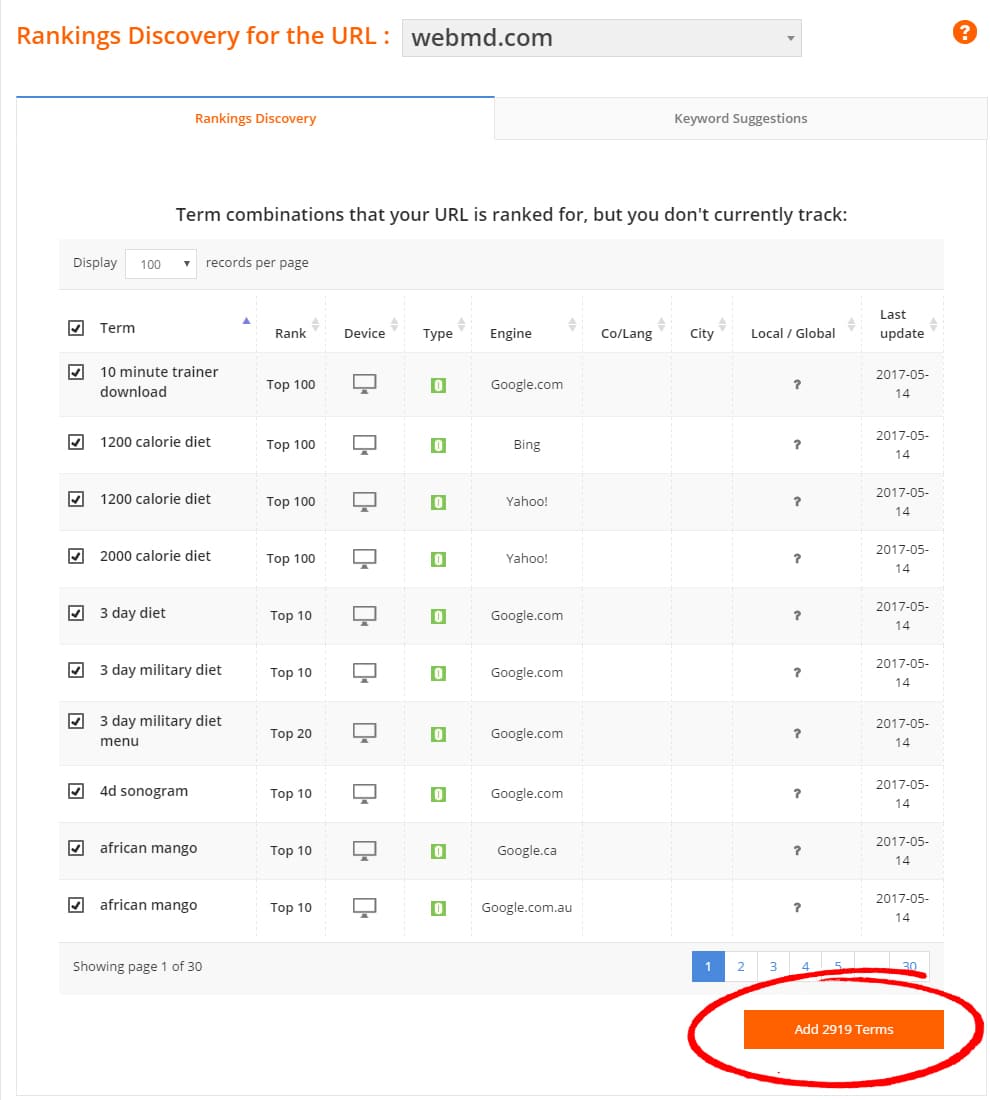
Rankings Discovery Keyword Suggestions
This tool comes FREE with PRT’s SERP tracker, and operating it is easy — any URL you track with PRT can be put into the tool, then any top 100 ranked keywords on record for that URL will be revealed before you, instantly. The tool, in a way, reverse engineers the search process and will only become better as search engines evolve.
What can you do once you’ve discovered all these keywords? Simple — promote them to top 10 positions! As these keywords are already in the game, it will be much easier than promoting them from scratch, and the additional organic traffic your website will receive will be well worth the extra effort.
A few more SEO-centered applications to this tool:
  • Bring value and insight to future clients. If you are meeting a potential client whose website already has some presence on search engines, use the tool to see what keywords are ranked top 100 for that website. Show them what keywords are already ranked and which ones can rank even higher.
  • Discover all the best keywords for almost any niche. By checking the top 10 leading websites of any niche with the tool, you can see what keywords are being promoted in that niche most of all. This is a great way to research a niche and get high-quality keyword ideas for tackling almost any niche on the internet successfully.
  • “Spy” on any website, and get the full picture of what they rank for. The same principle as above applies in this case: Input any URL into the tool, and see all the keywords on record that rank top 100 for that website. You can use it to research competitors or as an aid to building your base SEO strategy.
Of course, these are just a few of the possibilities. All the potential applications and strategies are still waiting to be discovered! It’s all up to you. Give this tool a spin, and see for yourself what keywords you can discover for any website.


Reference:https://www.searchenginejournal.com/the-amazing-benefits-of-discovering-your-hidden-ranks/199946/

Tuesday, May 30, 2017

What B2B Marketers Must Know About SEO in 2017

What B2B Marketers Must Know About SEO
Staying on top of SEO best practices and increasing organic traffic is a priority for many B2B marketers. The more targeted buyers you bring to your content, the more you will increase your conversion rates and generate leads.
I sat down with Stephen Johnson, resident SEO expert at Salt Water Digital, to find out how search engine optimization is affecting B2B marketers in 2017.

Q: How has SEO changed in 2017?

Stephen: Google made some major updates in the early part of 2017 that we are still trying to understand. Many of the core principles of SEO remain valuable. But we need to determine what best practices will move the needle the most.
The two most important SEO considerations are content and domain authority. It’s important to publish high-quality, long-form content, as search engines send traffic to pages that are authorities for keywords. Pages with thin content won’t perform as well as pages with longer content.
However, content isn’t everything. The strength of your domain is still critical. A domain’s age, size, and popularity determines its authority. A site gains authority when other sites with high authority scores recognize it.
To improve your domain authority, focus on link building.

Q: Everyone talks about link building. How do you effectively build links?

Stephen: Passively waiting for backlinks is not an effective way to improve your SEO. You must be proactive.
We recommend two strategies for building links. The first involves using industry-specific citations or directories. Most industries have online resources where you can list your company or provide content in return for a link, such as through an interview or a guest post. Providing your expertise on blogs is an excellent way to acquire links.
While some directories aren’t high impact, they can still support your link-building efforts. Industry blogs and resources often have high domain authority – not to mention the respect of your customers. Find out which sites can provide you with high-quality links and form relationships with their editorial team.
The second strategy is to outsource your link building to an SEO company that can take care of everything for you. However, it’s important to learn how they plan to acquire links to your website so that you can avoid penalties from Google.
For example, ensure that they won’t use black hat techniques that spam your site around with low quality or hacked accounts. Avoid Fiverr at all costs. You should also find out which websites they will get links from and check their domain authority using MOZ.

Q: Are one-way links more valuable than linking between websites?

Stephen: Google looks for logical link building. Does the link make sense?
For example, you can’t add your financial planning software to a website about dogs. The website doesn’t have any relevancy, and Google will recognize this. Industry relevant links are important.

Q: To avoid thin content, is it better to have one long post per month instead of four shorter posts?

Stephen: You don’t need to write super posts all the time because you’ll burn out and send your blog to an early grave. But the meatier your content, the better.
Write at least 500 words for your blog posts and product pages. Mid-length content will go a long way in improving your SEO.
But don’t create fluff articles just to meet your blog’s deadlines. You must produce useful content. Hire a copywriter to ensure that your content is something that your customers want to read.
Also, include images and videos whenever possible. When you add media to your content, you can tag it with keywords and increase your chances of getting found. Google wants to provide search results with great content – including images and especially videos. The more media you add, the better more likely your content will succeed.
The content you create – whether text or media – should relate to your targeted keywords. You should also interlink and optimize it using anchor text. Meaning, if you want to rank for “HR software,” use this phrase as your anchor text when you interlink between your blog and your product page. Don’t use “click here” as your anchor text.

Q: Should all B2B companies focus on SEO?

Stephen: SEO isn’t for every business. Optimizing the SEO for a B2B company can be tough. Many B2B keywords have low search volumes when compared with B2C keywords. This makes achieving ROI challenging, as you might target keywords that only get a few searches per month. In these cases, I recommend investing in PPC strategies.

Q: If my keywords have a low search volume, will I get any value from SEO?

Stephen: Yes. Even if the keywords that describe your products or services have a low search volume, they could still provide you with value. For example, optimizing for specific phrases can bring targeted buyers to your website. These customers can go on to purchase something that costs thousands of dollars – making your SEO investment worthwhile.

Q: What mistakes do you see B2B marketers making with SEO?

Stephen: When B2B companies tell me they are “doing SEO,” I often see a disconnect in what this means. Many aren’t doing anything other than adding keywords to their web pages or blog posts.
Also, some B2B companies fail to perform keyword research. They guess what people are searching for, rather than doing research to find out what customers actually look for. You can use free tools, including the Google Keyword Tool, to see which phrases your customers are using.

Q: What are your favourite tools?

Stephen: There are a number of tools that I find helpful for marketers. Moz is a great tool to check your site’s domain authority and get an idea of what links already point to it.
If you’re interested in checking out the competition from an SEO and PPC perspective, Spy Fu is really cool. It gives you an idea of what your competitors are doing to get found online.

The Google Keyword Planner is the tool that I use the most for clients. The foundation of SEO is knowing what people are searching for, and the Keyword Planner shows you this information.Finally, I use SEMrush for its keyword tracking capabilities. It is fantastic if you are pursuing aggressive content strategies, as you can clearly see how your content performs from an SEO perspective.

Reference:http://www.business2community.com/expert-interviews/b2b-marketers-must-know-seo-2017-01847098#768dqujEC2t3qTBm.97

Friday, May 26, 2017

5 reasons to give SEO experts a seat at the website planning table

Photograph of people brainstorming around a table. 
 
Maybe it’s your company’s yearly planning session, or maybe the meeting is being called because your website is in dire need of a refresh.
Whether the goal is to help form a new layout for the website, or to start creating the content calendar for the year, the planning sessions will naturally have product heads, key executives, and marketing managers in attendance.
As your company conducts this careful planning process and dreams up the site’s future, there’s one other important voice that should be at that table: your SEO expert. Whether this is an in-house individual or an external SEO agency or consultant, the knowledge this person can provide will have a critical impact on the site’s ultimate success.
Here are five ways that your go-to SEO expert can positively affect the outcome of your website project:

1) Ensure that your site has a design that’s search engine friendly

Just as it’s the job of your designers to ensure that the website is inviting and communicates elegantly with users, your SEO expert’s responsibility includes making sure the site communicates all the right information to search engines.
Your SEO lead can help tailor a site design that delivers essential company/product information from the homepage, in a way that assists search engines in efficiently learning all they need to know about your site. By doing this, your SEO expert sets the stage for your site to be viewed more favorably when it comes to organic search rankings.

2) Discover and make the most of content opportunities

Your content specialists ought to work hand in hand with your SEO expert to craft content that has legs and delivers business value. The right content selection process can lead to subject matter that works for you, naturally pulling in traffic by providing desired information on the correct topics.
Your SEO expert can really help inform this process, identifying those content opportunities that will bring in new customers and then optimizing that content so that it receives the visibility it deserves.

3) Optimizing updates to page content, metadata, and locations

When making any changes to the structure of your site, make sure your SEO expert is involved.
How your site is designed to move visitors from page to page – and the content and metadata within those pages – have a determinative effect on how search engines value your site. Your SEO expert can inspect the user flow of your site’s pages and suggest any content changes that would be beneficial.
Your expert might also take the opportunity to rewrite metadata and update pages to follow the best practices for heightening visibility in search engine queries.

4) Utilize the possibilities of off-page content

From videos to presentations and beyond, remember there are opportunities to gain visibility for your brand away from your website. In certain cases – which your SEO expert should be able to recognize – these pieces of content can ultimately contribute to your brand’s SEO by enhancing your overall presence in search engine results.
For example, a video screencap displayed in search results can capture clicks and attention, and ultimately increase traffic to your site. 

5) Execute large-scale SEO initiatives

When making preparations for a site redesign, it may also be an optimal time to pursue major SEO initiatives.
Some site-enhancing projects worth considering: adding HTTPS to make the site more secure (and trustworthy for visitors), or adding schema markup where appropriate – likely for videos, recipes, products, etc. – to enable search engines to provide users with more informative results.


Reference:https://searchenginewatch.com/2017/05/09/5-reasons-to-give-seo-experts-a-seat-at-the-website-planning-table/

Thursday, May 25, 2017

How to Boost the Organic Visibility of Category & Tag Pages?

Category and tag pages are considered “weak” in SEO since they have very little content. Normally they have image thumbnails with a “Read More” link. How can we optimize these types of pages to increase their organic visibility?
I’m assuming you’re talking about category and tag pages like you’d find on a blog (like WordPress). Where all it really provides is a repeat of all the information available elsewhere on the site in a re-organized way.
I think where people go wrong most often is having too many categories or tags. You want your categories and tags to be mutually exclusive. In other words, you don’t want category=blue widgets and tag=blue widgets.
There are a few things you can do to make these more valuable and therefore more useful to search engines and their visitors:
Is your PPC Agency Wasting your Budget?
Find out by downloading a FREE copy of our complete guide to the DO's and DON'TS of your PPC agency.
  • Define them carefully. Set some plan in place and stick to it. Maybe categories will be intent based (like News, Fashion, and Promotions) and tags will be product based, like dresses and shoes. Whatever you decide, just make sure they serve different purposes.
  • Choose nomenclature that is inclusive rather than exclusive. Try to limit tags to just one per topic, and only 2-3 per post. In other words, you wouldn’t tag a single article with “dresses”, “summer dresses”, and “sleeveless dresses”. You’d just tag it with “dresses”, and maybe “sleeveless” or “summer”.
  • Provide some summary or description of what’s in each category or tag page. For the category page, maybe you can have a description of the category appear on the page along with a few featured posts on that topic and some pins on that topic from your Pinterest account. The idea is to make the page a hub of information on a specific topic, beyond just a relisting of posts in that category. It should be the same with tag pages.
If this is more effort than you’re willing to give, then just noindex them.
Category and tag pages aren’t duplicate content per se, but they do waste crawl budget (the time search engines spend on your website gathering information), especially if you have thousands of similarly tagged or categorized pages.
If you can’t see a reason why someone would bookmark your category or tag page to refer back to, then it’s unlikely a search engine is going to want to send people there.

Reference: https://www.searchenginejournal.com/category-tag-pages-seo/199598/ 

Wednesday, May 24, 2017

Paid Search Optimization: A Management Approach for Success

Paid Search Optimization: A Management Approach for Success 
 
As SEM managers, account optimization is ingrained as a core competency, but what does it look like to actually grow an account? If an account can spend a given budget each month while maintaining a goal ROI, growing an account means increasing budget incrementally (even doubling) while maintaining the same ROI.
Any good account manager can maintain the same media spend while remaining efficient — but great ones can grow an account. And to grow an account, a strong management approach is essential.

Purpose of a Management Approach

Rather than jumping in an account to simply lower CPA, a strong management approach can yield numerous benefits:
  • Long-term and consistent performance with growth and scalability
  • Strategic direction
  • Prioritization assistance
  • Innovation

The Beginning of a Management Approach

When managing an account, first find what works well. This may be a set of keywords, a specific campaign, or a combination of tactics.
The next step? Dialing in enough to dominate and completely capitalize on what is working well.
From there, it’s all about integration. In PPC, this could be integrating your front-end data with third-party data sources. It could also mean integrating your team’s efforts with advanced business intelligence. Once you’ve found what’s working, capitalize on it — and integrate.
Aimclear PPC Management Approach

Define Goals & Objectives

Communicating with your stakeholders on goals and objectives is the first — and most vital — part of a management approach. Find out what your team is actually responsible for and to what capacity.
Identify areas of current success for advertising and sales teams. Once you align with your team on your responsibilities, you are set to move forward.

Understand Budgets & Breakouts

Within overall budgets, it’s common to have multiple services or products that must be promoted. It is at this point that budgets should be structured to define goals. By allocating specific amounts of budget by product group/service, ROI, CPA, or ROAS, goals can then also be attributed to each group.
Once individual goals are set based on the nature of business, an overall CPA goal can then be backed into. Defining budget breakouts and goals not only aids in performance but also in communication with stakeholders, as there is now an open dialogue about how each product/service group contributes to (or hinders) overall performance goals.
Aimclear Goals & Objectives

Assess Efficient Spend Capacity

Efficient spend capacity is the amount of budget an account or keyword set can spend given a specific CPA goal. There are many facets of efficient spend capacity (e.g., what is an affordable CPA goal, the quality of current keyword sets, budget size, as well as seasonality and market trends).
When approaching an account given a finite budget, it is important to maximize spend through brand keywords and best non-brand keywords. The below example dubs this group as the account’s ‘A-Level’ keywords. Many times A-level keywords end up being strong target + bid RLSA candidates.
In most cases, an entire budget cannot be siphoned through these keywords alone, so the next best keywords will need to be introduced (‘B-Level’). These keywords may have an average CPA above the goal CPA, but never fear: The average across all keyword groups will remain below the goal CPA due to the volume generated from brand and A-level keywords.
Lastly, we may have to introduce some fairly expensive keywords to test and exhaust budgets. These are labeled ‘C-Level’ keywords.
In instances of budget influxes/reductions or aggressive CPA goals, efficient spend capacity can be improved by increasing the amount of budget spent through Brand, A-Level, and B-Level keywords. The more budget funneled through those keywords sets the capacity of spend at, or under, your CPA goal.
Understanding the concept of efficient spend capacity will help in explanations of the relationship between amount of budget spend and efficiency in your account to stakeholders. At the end of the day, account growth is essentially an increase in efficient spend capacity.
Aimclear Brand Keywords

Structure for Long-Term Success

This can be a scary term for anyone working in and around an account. Many people think that ‘restructuring’ refers to complete revisions in an account. This is all but true and can be a counterproductive approach to increasing efficient spend capacity.
Structure, in this case, refers to setting up an account in a way that allows proper flow of data for true optimization.
In the end, the goal is to have everything tracked and tagged correctly. From there, a seamless flow of data will inform both reporting and optimizations.
What is most crucial, however, is not breaking out the account so granular that data is limited. The most common example: breaking out a campaign so far that it lacks data, either due to data splitting between assets or lack of budget allocation. If not enough data is available to work with, it will be difficult to optimize or report. So set thresholds and decide which level of granularity works with your business.

Optimize & Test

This is a day-to-day effort. However, it’s easy to completely waste time optimizing and testing if the previous steps have been neglected.
For example, if goals aren’t considered when you realign, it’s possible to optimize everything to a goal completely out of alignment. Even worse, KPIs could be different than what is actually being measured, which could completely change the account.

Expand

Expanding the account is the last and most important goal of a management approach. Expansion ultimately comes from expanding efficient spend capacity, which is increased by testing new keywords and targeting types.
This alone won’t do the trick — make sure to have proper account structure and setup to give a true flow of data. From there, continuous, quality optimizations and tests will make keyword and target testing more successful.
Nothing truly great happens overnight. It takes time, work, and strategy. This is especially true for SEM accounts. Developing a strong management approach will set you up for growth and success not just for the next few months, but for the lifespan of the account.

Learn more about Aimclear’s search and integrated marketing capabilities.

Reference :https://www.searchenginejournal.com/paid-search-optimization-a-management-approach-for-success/198727/


Tuesday, May 23, 2017

4 Tips That Will Prepare You for the Future of Search & SEO

The more things change, the more they stay the same.
We are experiencing a period of unprecedented flux in the search industry. But dig deeper, and there are some elements that hold stubbornly true.
Historically, search has been about Google and it has been about text. There has been a shift in this relationship, as voice-based digital assistants like Amazon’s Alexa take hold, and search results become much more varied.
The way we approach search has also changed. Search is now central to most marketing teams and it encompasses a wide variety of skillsets. Everyone from the CMO to the creative team to the data analysis specialists has a vital role to play.
This provides a lot of food for thought for modern marketers. Enough for an all-you-can-eat thought buffet.
Just some of the big trends in our industry in 2017 are:
It used to be so much simpler, right?
All of this can be disconcerting. So how can we stay on top of so much change?
If you react to every new, shiny update, you’ll fall into a trap. The faster our industry changes, the slower we should be in our decision-making. The choices we make now will shape how successful we are over the next few years, so it’s worth taking the time to get them right.
Search Strategy

There are some comforting constants within all of this exciting flux.
The act of searching has not changed; it depends on an accurate answer to fulfill its function. Search engines are getting better at judging which answer is the most relevant and for that, we should be grateful. The industry has a long way to go, but the path we are on is a constructive one.
Therefore, with one eye on the present and the other on upcoming trends, we can set ourselves up for short- and long-term search success.
Below are four tips we should all bear in mind as we prepare for the future of search.

1. Use Psychology & Technology to Shape Strategy

People don’t change as quickly as technology. Marketers should understand the psychology behind their audience’s actions.
These eternal marketing principles will take center stage once more as search grows in sophistication. It is in understanding the full breadth of potential interactions our customers can have with our brands that we can thrive in this new ecosystem.
The hardware used to find this information may change, along with the search engine used to power it. However, the user behind the query will have the same impulses and requirements they always had.
Sure, the form these queries take will advance in lock-step with technology. We have seen this with longer queries via voice search, for example. We will see this more and more as users tap icons rather than typing queries.
This is exactly why we shouldn’t chase shadows by targeting specific search queries.
Knowing which keywords led visitors to your site is useful to know. It always will be. But from a strategic standpoint, gaining insight into the intent behind that keyword will be much more valuable.
Search Psychology
Both quantitative and qualitative resources are required to reach this level of comprehension into consumers.
This is where we can use technology to our advantage.
Your company’s CRM data can be a goldmine. Even the humble survey still has a role to play.
If you want to know what people are thinking, ask them. Combine this with what you see in your analytics and CRO software to get an idea of what truly leads a customer either to engage or disengage with your brand.
Psychology is the foundation of a great search campaign. Technology enables us to create a stronger foundation than ever before.

2. Structure Your Site Around Topics

Taking this approach to research will provide you with a rounded view of your customers’ preferences and requirements. This then becomes a fantastic resource when you consider the structure of your website, as you can build topical hubs for semantically related content.
We have been talking about this way of structuring sites for quite a while now. The logic is sound: Map different sections of your website to different products and services and, within each, cover every point of the consumer journey with different landing pages. This lends itself to a URL structure that is great for search engines and users alike.
This can be extended to encompass your apps and social media profiles, should they be a more fitting home for certain types of content.
What this provides is a perfect platform to populate with a variety of content formats. Informational pages may benefit from videos while transactional pages require structured, clear answers to pressing questions.
Hierarchy
Let’s take as our example an insurance brand. Applying this approach, we would have separate sections for each type of insurance.
Is your PPC Agency Wasting your Budget?
Find out by downloading a FREE copy of our complete guide to the DO's and DON'TS of your PPC agency.
We can consider the lead product page in each section to be the main content. This is then supported by supplementary content, which supports the main product page by adding further color and guiding users towards an informed decision.
Often these supplementary pages can be migrated from the blog, with some minor amendments. As a result, your product hub will cover everything from [what type of car insurance do i need?] to [get car insurance online].
This adds to your authority as a reputable resource and allows you to nest all related content within sub-folders under the main product.
Wherever the industry takes us in the next five years, this approach to site structure will have merit.

3. Think Beyond Google

Searching implies the requirement for an answer. The transmission of those answers may differ by channel or search engine or by media format, but search is just a vehicle for the information.
In fact, search engines only have access to our information once we choose to put it in their hands. They are not the creators of the content, but they form an essential link between demand and supply.
Google has been a dominant presence in our landscape, although competition is increasing as user behaviors differentiate. And yet, this is driven by a core truth: People are simply seeking new information.
This is important to remember as we ponder the rise of Amazon as an e-commerce search platform, or as Pinterest’s visual search technology evolves. Yes, we should learn how to code Skills for Amazon’s Echo. Undoubtedly, we should know how Pinterest’s “similar items” feature functions.
Nonetheless, this should not come at the cost of creativity. The age of generating content just to fit how we think Google ranks results is long gone. If we try to manipulate our way into a wider array of search engines and media formats all at once, we will lose sight of what is important. Moreover, we’ll have no time left to create anything of worth.
Creativity
This new era will reward genuine creativity and research over ‘quick win’ tactics. The future of search should actually be much more unified, from a strategic perspective, in the sense that we require one cohesive plan across all of those touchpoints.
That has not always been the case; often we have had to make do with the acquisition stage, which is harder to deliver on when you don’t really shape the awareness or consideration phases.
Where we need to upgrade our skills is in the area of content discoverability. Whether it is through Schema.org markup or creating Actions for Google Home, our focus should be on making it as easy as possible for any digital assistant or search engine to find and serve our content.

4. Devise a Flexible Measurement Strategy

We need to measure all of the above in a more nuanced way, bearing in mind that personalization is still an untapped opportunity.
Much has been made of personalization in search for a few years now, but true personalization is still on the horizon. This will be great for marketers, no doubt.
Personalization will, however, present us with new measurement challenges.
Search results will never be static. So how can we measure our ranking performance?
Furthermore, we need to know how to evaluate the success of our content across media platforms and social networks.
The key point in this area is to accept the importance of flexibility in a measurement strategy. The expectations of a video embedded within an informational page will differ greatly to those of a product launched on Amazon. A piece of content that gets links will be different to one that gets social shares, typically, and those will differ greatly from content that converts customers in volume.
Flexibility
Therefore, the communication of our measurement strategy is just as important as its component parts.
We need all parties to buy into the fragmented nature of search as we move away from being a pure, direct response channel.
This can be a very fruitful approach for businesses and may end up being a more varied and satisfying role for search marketers.
Of course, we need clarity in our data to achieve any of this success.
Hopefully that data will be shared by all digital assistants, which will give us insight into performance across devices.
We should also expect Google to split out voice queries within AdWords and Search Console (a feature they have tested already), which will at least provide a little transparency within voice search performance, too.
By using a unified reporting solution with tailored dashboards for different stakeholders, we can share our successes and learn constantly.
Our industry is changing, for sure, but it is changing for the better. The savviest marketers — and communicators — will reap the rewards.