Friday, June 16, 2017

How Social Media Marketing Improves Your Google Rank


In boosting your search engine ranking, it's almost criminal to exclude social media marketing, especially given its pervasive presence online.
Last year, nearly 70% of people worldwide used social media in one form or another. Also in 2016, 2.34 billion people had a social media presence, and stats predict that this will increase to 2.67 billion by next year.

Number of social media users worldwide from 2010 to 2020 (in billions)


It's not clear how Google really gauges social media when it comes to ranking websites. That's understandable, considering the search engine has always been very secretive about its algorithms. What's clear at this point, however, is that social media does help in driving traffic to your site, albeit indirectly.
The correlation can be found in the top ranking websites, which also have very strong social media signals. So even if Google says that social media shares don't really count as one link, a large volume should account for something.
Below are just some of the ways social media marketing can boost rankings:
Cultivates Relationships With Customers


Social media provides an easy platform where businesses can directly interact with their customers. More than superficial interaction, it actually allows you to develop a relationship with your clientele. Successful use of social media even gives the power to the consumers to dictate how product value is offered. It's not just about numbers, but rather making them feel that they have a stake in the company. Cultivating your customers through social media will drive more traffic to your site, resulting in a better ranking on Google.
Links to Your Website
The main purpose of social media is to raise awareness of your product or service. The main goal of Google, meanwhile, is to give the most relevant result when users submit a query. Posting your web address on your social media page—and asking your customers to share it—will also drive traffic to your website.
Businesses are always trying to figure out where their customers are, especially if their websites fail to get traffic even when they have existed for quite some time. Social media offers a ready customer base, with its almost three billion population. The trick is how to harness it.
Means to an End
You should keep in mind that social media is just a means to an end, as Google doesn't really recognize any of it in its search engine results page (SERP). Knowing this, it's important for you to make great content that can possibly go viral. YouTube, in fact, has become the battleground for marketers to create the next viral video. It may not directly lead traffic to your website, but it does make for perfect brand recall. Of course, knowing the attention span of Millennials, you'll need to routinely churn out great content to be effective.
In sum, just remember these simple steps to boost your Google rank with social media.

  • First, create an account on social media—particularly the big four of Facebook, Twitter,Instagram,and YouTube—whichcan help drive traffic to your website.
  • Second, fill your social media account with great content, with proper search engine optimization techniques, to make sure Google crawls through the page and indexes it in their search engine results page.
  • Third, make sure that the viewers or readers can see the share button to make it easy for them to post your content on their own social media accounts. Afterward, just wash, rinse, and repeat.
Customers, however, are not as keen to forgive on social media, as compared to websites, when the company fails to respond immediately. As such, it's best to appoint an administrator tasked to respond to queries or complaints on your social media page so your customers walk away happy. This increases the chances of visitors recommending your business to their families and friends.

Reference:http://www.webpronews.com/social-media-marketing-improves-google-rank-2017-06/

Thursday, June 15, 2017

How to Promote a Small Website: Content, Social & Link Building


How to Promote a Small Website: Content, Social & Link Building
Small website optimization is extremely tricky, especially on a limited budget. But that’s why you should actually double your marketing efforts. You need to promote your website, attract traffic, and slowly build your way to the top (where the magic really starts to happen).
Here’s how to simply and effectively promote a small website and help your SEO efforts go further with a content strategy, social media marketing, link building, and PPC marketing.

Content Strategy

The following process will help you craft a detailed content strategy and produce content that matters.

Be Smart & Realistic

If your site is small and drives no traffic, you must have plenty of content and a solid content plan. High-quality articles, infographics, videos, and e-books should become a cornerstone of your growth strategy.
You can’t be everything to everyone, though. Be realistic when you set your content goals.
If you want to drive traffic, you need some content. If you can only post one single, high-quality article a week, then do so.
Your goal is to put something useful and powerful, something that can help people resolve their problems and soothe their pain points. Don’t break your back trying to produce tons of low-quality content that nobody needs.

Analyze Your Competitors

Analyzing what your competitors do (or don’t do) can help identify sweet spots for your content in the same niche. Some tools you can use to gain many content insights:
  • SimilarWeb
  • Ahrefs
  • Majestic SEO
  • BuzzSumo
  • Klout
If you lack funds to purchase the subscriptions of the listed tools, consider using SimilarWeb and Ahrefs. You can use SimilarWeb for free pretty efficiently to sift out your competitors by traffic and distribution channels. Ahrefs will help when researching top content and content ideas. It is worth trying even if you are working with little to no resources and have to choose one tool to purchase.
Once you find the perfect role model for your site’s content, don’t just copy its strategy. Rather than parroting what everyone else is doing, you want to find your own unique content approach. Eventually, this will make optimizing your small website much easier.

Figure Out What People Really Want

Getting the inside scoop on your competition is important. But if you want to scale your business, you should do everything you can to know your audience. To do this, you have to answer two questions that may appear simple, but really are quite tricky to answer:
  1. What do I offer to my target audience? Think long and hard about the first question. Ask your employees, colleagues, and even friends and relatives to help.
  2. What does my target audience search for? You will need to go over search suggestions on Google, Quora, and Yelp. Sites like Medium can also provide insight into how your users think and what they are looking for.
Answer these two questions and you will never have problems getting your point across to your prospects. You’ll also never fall short of ideas when generating content.

Just Write It!

Once you have a list of ideas on the table, you have to dedicate a chunk of your time and resources to content production. For many, the actual production of content can often be difficult and tedious, but this is a critical step to move your content strategy forward.
High-quality content depends on many factors and everyone has their own way of creating content. While there is no one-size-fits-all formula, here are some basic things you should keep in mind:
  • Create deep, well-researched content.
  • Write down every idea you come across.
  • Don’t edit while you write; leave editing for later.
  • Produce content that is at least 800 words.
  • Prioritize user intent, not keywords.
  • Research long-tail keywords.
  • Come up with a headline that sparks curiosity and provides value.
  • Add compelling visuals to your text content.
  • Stick to a regular schedule (create a content calendar).
  • Don’t forget to share your content.
With this simple framework in mind, you can come to grips with content generation. Practice makes perfect.
You’ll inevitably face different challenges and might not see the results of your content strategy right away, but don’t let this discourage you. Content pays off in the long run.

Social Media Marketing

Once your site is optimized and your content is published, it’s time to share it. While this step doesn’t deal with SEO directly, sharing your content, and nurturing a loyal following on social media are keys to drive traffic, improve engagement, and increase conversions.
Simply sharing your blog posts on Facebook and Twitter isn’t a terribly effective strategy, especially if you own (or promote) a small company. So how do you build a solid base of brand advocates?

Analyze Your Target Audience

To nurture a following, you need to know who you want to target. Failure to do so can spell death for your online efforts. To nurture a following, you need to connect with your audience on an emotional level.
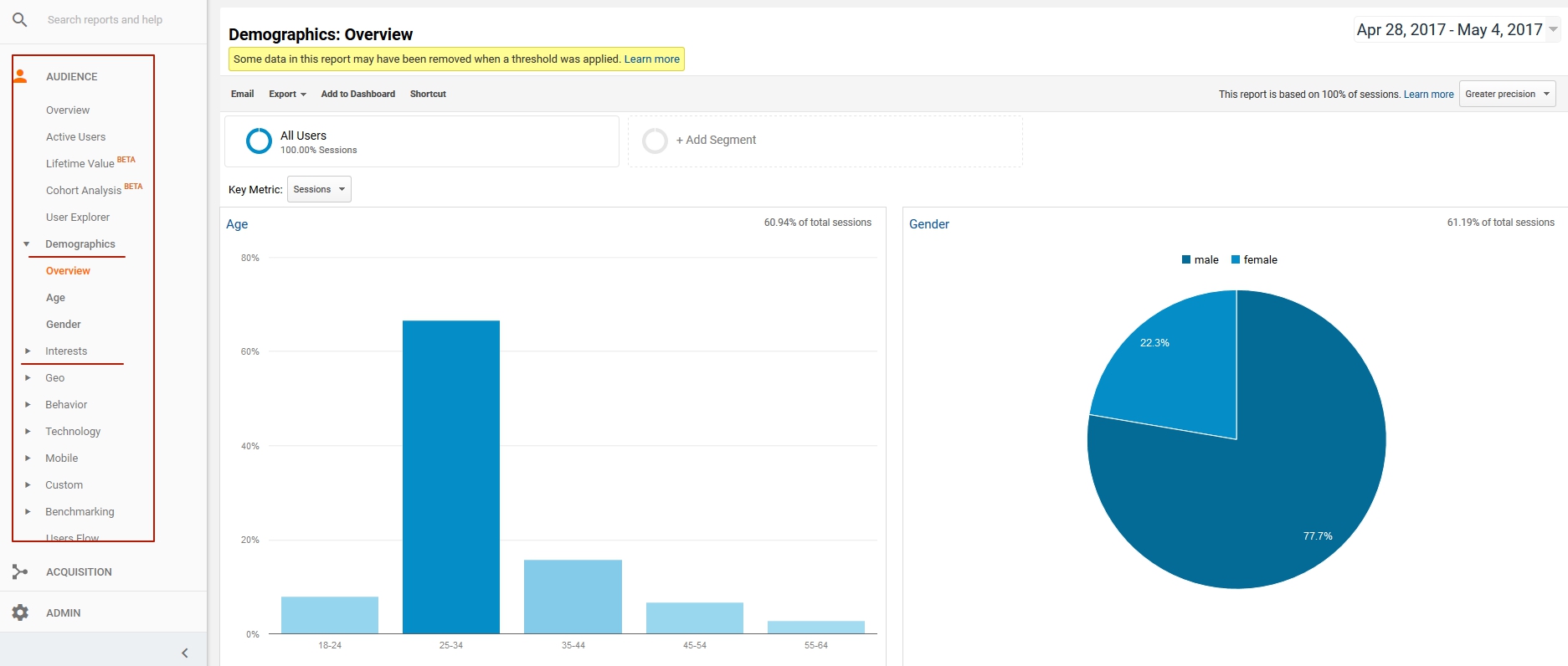
To research your target audience, access Google Analytics’ Audience feature. Make sure you look through every tab but pay specific attention to the Demographics and Interests tabs.
GA demographics
This will give you a clear picture of who your prospects are then you can figure out how to appeal to them.

Build Trust and Authority

Trust and authority are absolutely key to your success. If people neither trust you nor view you as an authority in the industry, why would they visit your site or “like” your Facebook page?
Here are some ways to establish yourself as a credible site:
Download Your Competitors SEO & PPC Campaigns
Get instant access to competitive insight that will help you increase your traffic and increase profit. SpyFu is free to try. No CC required.
ADVERTISEMENT
  • Create and share high-quality content consistently.
  • Develop your own voice and mission (be different).
  • Tell stories about your brand, be useful, and solve problems.
  • Give away great content for free.
These are your pillars to building trust and authority. For additional methods to try, I recommend looking here.

Share on Select Social Networks

Most digital marketers and small business owners fall into the trap of targeting the mainstream social channels like Facebook, Twitter, LinkedIn, Instagram, Pinterest, and Snapchat all at once. This is a huge mistake, especially if you lack the budget.
Start by targeting one social network. Then replicate your strategy on other platforms later.
Start with Facebook. Pretty much everybody uses it. Share educational and entertaining content (e.g., links to blog posts, GIFs, memes, videos).
Also, allocate a portion of your marketing budget to boost your Facebook posts. This way you not only increase post reach but also target your demographic more specifically.
After Facebook, Twitter is your next logical step. Again, don’t just share the same content on your Twitter feed. To get on the radar of your target demographic, post and retweet great content, follow influencers, and press as many red hearts as possible. You have to hustle on Twitter to get noticed.
Tip: If your brand includes plenty of visuals (like in fashion or beauty), it makes sense to target Instagram and Pinterest. But make sure you share high-quality pictures. Posting subpar content won’t work here and can actually hurt your marketing efforts and brand perception.

Select Smaller Social Media Platforms to Target

On top of major social networks, I strongly advise targeting Quora and Medium as well.
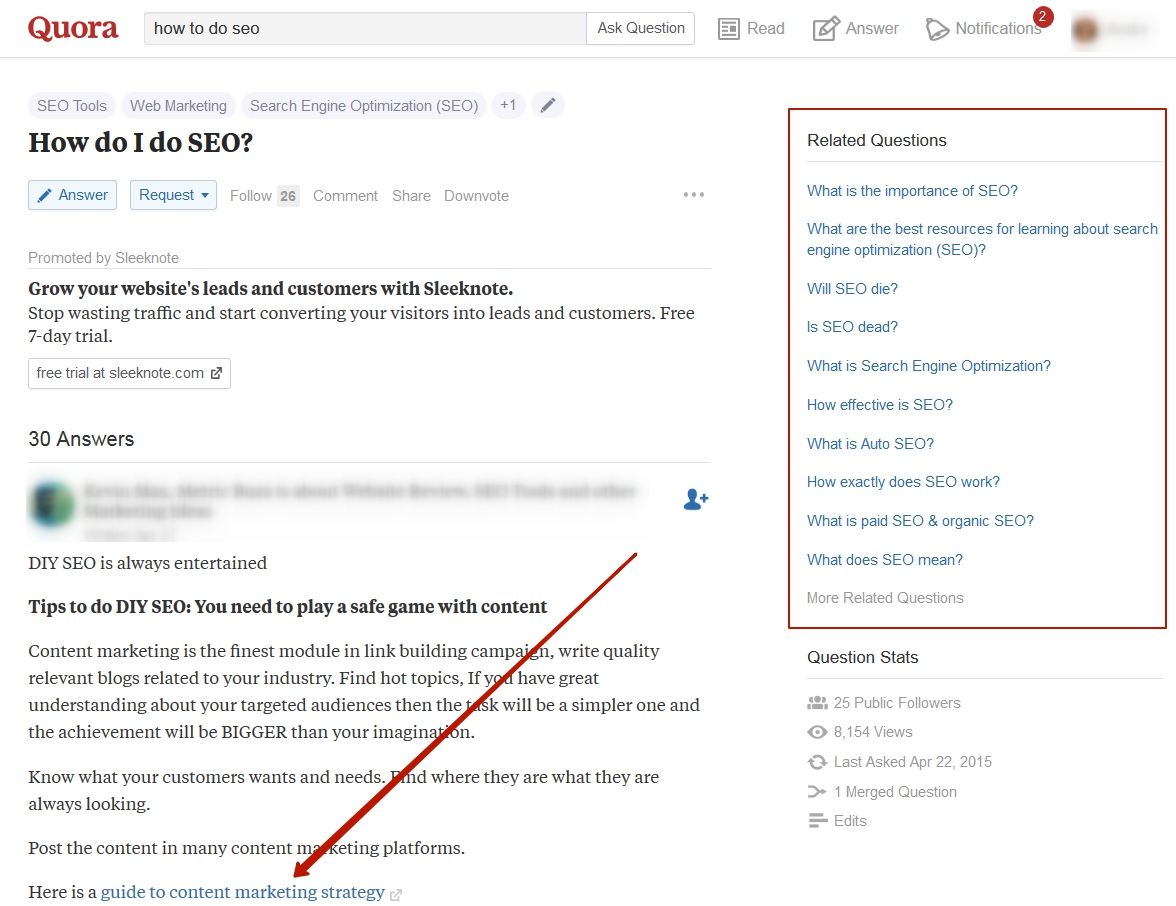
Quora can work miracles setting you up as an authority in the industry. Write useful answers to relevant questions and you will quickly build a solid base of followers. Then, start placing links that point to your content and a steady stream of prospects will visit your site.
building a following on Quora
If your digital marketing and SEO strategies are mostly content-focused, establishing a separate Medium publication can boost your business authority. It can help you refine and reinforce your message while pushing out more natural, conversational content.

Build Links to Blog Posts & Landing Pages

While your main focus may be on your brand following and on-page elements, don’t forget to dedicate some of your precious time to off-page, too. For an established, large corporation, off-page optimization is typically already taken care of because:
  • Off-page routines are partially covered by content and SMM strategies.
  • High-quality content is the best way to attract links naturally.
  • Google is all about natural link building.
But as a smaller company with a limited budget, you will have to give your backlinks a nudge and take time nurturing your off-page factors. Here are a few easy ways to strengthen your backlinks:
  • Register your site in directories and listings.
  • Reach out to pitch media, bloggers, and influencers.
  • Write guest posts.
  • Promote scholarships (.edu and .gov backlinks).
All of this will slowly start building links to your site. Just remember that you’re not aiming for quantity here — be picky because the most helpful links come from relevant and trustworthy resources.

PPC Campaign

This one is optional, so I won’t go into too much detail here. If you lack the budget or don’t have previous experience running a cost-efficient pay-per-click campaign (or any campaigns whatsoever), you may want to wait on launching a PPC strategy. A poorly executed campaign can eat up your budget and return zero results.
If you feel confident in your abilities to launch a PPC campaign, here are 11 things you need to do:
  • Define your goal before you start.
  • Determine your budget.
  • Identify relevant keywords.
  • Analyze these keywords to sift out negative ones.
  • Bid on selected keywords.
  • Use one keyword per ad to maximize your chances.
  • Write catchy headlines for your ads.
  • Include informative copy that appeals to your audience.
  • Target ads to landing pages that align with the ad’s intent.
  • Analyze and monitor your ad performance.
  • Enhance the ads and change bids when necessary.

Conclusion

You don’t need a huge site or massive budget to start driving decent amounts of convertible traffic to your website. Anyone can get things off the ground and slowly make their way to the top.
Putting SEO strategies on the back burner because your site is small is detrimental. SEO helps you attract consumers.
If you feel that doing anything on a small budget or without any budget at all is impossible, don’t worry! While it certainly won’t be easy, it is doable.
The most important thing is to maintain an open mind and be receptive to learning from mistakes as you launch your small website optimization strategy. With plenty of practice and a bit of due diligence, you can optimize your site to be on par with the best of the best.


Reference:https://www.searchenginejournal.com/optimize-small-website-content-social-links/197741/

Wednesday, June 14, 2017

Things To Know About Social SEO For Twitter


social seo twitter 

What is Social SEO?

Social SEO is improving our social media presence and driving traffic to website using various social media platforms.Twitter still can be helpful with Google SEO – Here is How 

Honest and Natural Links in content – in this case also, content will be the key factor, we need to create the content with proper outbound links.

Optimizing your website – Changing a bit in our website pages/Posts easy to share among twitter will also boost up the page engagement, followers and traffic from the source.
Build genuine connections on Twitter – Social media platforms are full of spam accounts and not all profiles are valuable for your business, building a strong and relevant audience on twitter will help you get visitors who will stay on your website or most likely they may lead to conversion.
Targeting your Website visitors at right time – The Google Analytics report will help us in getting the time and day of week when most of the visitors are visiting our website from twitter. Tweeting and sharing website content will get more visitors.
Using keywords from SEO Strategy –  To get the relevant visitors from organic searches, using our SEO keywords for business in our Tweets will help us to get our posts ranked in SERP.
Using Twitter feed widgets to our website – Keeping in mind we have our SEO Keywords in Tweets, Embedding the news feed in website will give exposure to the targeted keywords.
Improving Personal information in Social media profile – This is the important part where we can cater our content which will be viewable by visitors on the first impression. Keeping It much attractive and keyword focused, may give a good position for Website as well as social profiles in SERP.
Optimizing keeping Bing in mind – Bing yet another search engine after google is still reading and considering social media posts and feeds in their search results. So where getting used by google or not these contents are still valuable for organic visitors.
Using Trending content – Our content may be outdated for that instance of time, keeping our eye on what’s trending on twitter recently, then creating content according to that will create a good engagement to tweets and profile.
Using Hashtags – Hashtags are the way to broaden our tweets to get it shown which the particular hashtag is searched. We are need to use the trending and relevant #Hashtags while posting any tweet.
Showing Interest in Other’s content – It’s not only about sharing and marketing only our content and business on our twitter handle, Re tweeting others tweets to our profile will increase the engagement on the profile.
Use of Images – Tweets with image are more likely to attract visitors then the text only tweets.
Analyzing Twitter Analytics – When it’s been some time posting and tweeting on your twitter profile, Its time to analyse the tweets’ stat by seeing the analytics data twitter provides. We can use it in very effective manner to know who are the people showing engagement on our tweets, we can then mould our content according to the interest.

Reference:http://www.iamwire.com/2017/06/things-to-know-about-social-seo-for-twitter/153068
You need to realize that SEO isn’t easy, fast or cheap. It’s advisable you try not to measure your SEO success solely or mainly based on ranking, according to Jeff Bullas. Other factors such as traffic, longer time visit, lower bounce rate, and more enquiries or sales are important factors you should also consider. In addition, it’s important to realize that SEO does not make up for the fact that your website is not exceptional. For a successful SEO campaign, your website has to deserve it. So take a good look at your website and consider if your user interface is up to par, if your design isn’t dated, if your prices are too high and if your content just plain sucks. Fix that, then do SEO to help achieve your optimization goals

Read more at: http://www.vanguardngr.com/2017/06/5-seo-mistakes-avoid/
There are certain trends and basic SEO errors that are continually repeated, and these make SEO more difficult than it should be. Jumia Travel, the leading online travel agency, shares 5 SEO mistakes to be aware of and avoid.

Read more at: http://www.vanguardngr.com/2017/06/5-seo-mistakes-avoid/
There are certain trends and basic SEO errors that are continually repeated, and these make SEO more difficult than it should be. Jumia Travel, the leading online travel agency, shares 5 SEO mistakes to be aware of and avoid.

Read more at: http://www.vanguardngr.com/2017/06/5-seo-mistakes-avoid/
There are certain trends and basic SEO errors that are continually repeated, and these make SEO more difficult than it should be. Jumia Travel, the leading online travel agency, shares 5 SEO mistakes to be aware of and avoid. Thinking Great Content Will Rank Without Optimization Content marketing is great, but it works better alongside SEO. Avoid thinking creating excellent content is a substitute for SEO. Yes there are examples of amazing content that ranks without intentional optimization, but these are more exceptions than the rule. SEO will remain important in getting your page to rank and will also ultimately improve user experience. Thinking Great Content Will Get Links Without Link Building Thinking your content will get links without additional effort will very likely result in a large percentage of your content sitting stagnant on the site. You need formal and effective link building strategies to optimize and put your content out there. Duplicate Content Duplicate content is when the same content appears in more than one web page (URL) within the same or different domain (website). The problem with this is that search engines would find it hard to decide which content to index and this will lead to it likely not showing the webpage in search results. Some examples of duplicate content include: duplicate versions of the homepage, duplicate URL (there’s a difference between www.example.com/Apple-Iphone and www.example.com/apple-iphone) and different web pages having nearly similar content. Poor Quality Site Structure Most times website developers don’t integrate best SEO practices into website structures, therefore the site structure is unlikely to support search engine optimization. This is mainly because website developers are not exactly SEO specialists. It’s best to create your website structure in a way that’s easy and intuitive to navigate for users. Try to avoid burying high authority web pages in site architecture as this can lead to a dramatic loss of ranking. A flat site architecture can help you get more users to your site through search engines. Unreasonable SEO expectations You need to realize that SEO isn’t easy, fast or cheap. It’s advisable you try not to measure your SEO success solely or mainly based on ranking, according to Jeff Bullas. Other factors such as traffic, longer time visit, lower bounce rate, and more enquiries or sales are important factors you should also consider. In addition, it’s important to realize that SEO does not make up for the fact that your website is not exceptional. For a successful SEO campaign, your website has to deserve it. So take a good look at your website and consider if your user interface is up to par, if your design isn’t dated, if your prices are too high and if your content just plain sucks. Fix that, then do SEO to help achieve your optimization goals.

Read more at: http://www.vanguardngr.com/2017/06/5-seo-mistakes-avoid/
There are certain trends and basic SEO errors that are continually repeated, and these make SEO more difficult than it should be. Jumia Travel, the leading online travel agency, shares 5 SEO mistakes to be aware of and avoid. Thinking Great Content Will Rank Without Optimization Content marketing is great, but it works better alongside SEO. Avoid thinking creating excellent content is a substitute for SEO. Yes there are examples of amazing content that ranks without intentional optimization, but these are more exceptions than the rule. SEO will remain important in getting your page to rank and will also ultimately improve user experience. Thinking Great Content Will Get Links Without Link Building Thinking your content will get links without additional effort will very likely result in a large percentage of your content sitting stagnant on the site. You need formal and effective link building strategies to optimize and put your content out there. Duplicate Content Duplicate content is when the same content appears in more than one web page (URL) within the same or different domain (website). The problem with this is that search engines would find it hard to decide which content to index and this will lead to it likely not showing the webpage in search results. Some examples of duplicate content include: duplicate versions of the homepage, duplicate URL (there’s a difference between www.example.com/Apple-Iphone and www.example.com/apple-iphone) and different web pages having nearly similar content. Poor Quality Site Structure Most times website developers don’t integrate best SEO practices into website structures, therefore the site structure is unlikely to support search engine optimization. This is mainly because website developers are not exactly SEO specialists. It’s best to create your website structure in a way that’s easy and intuitive to navigate for users. Try to avoid burying high authority web pages in site architecture as this can lead to a dramatic loss of ranking. A flat site architecture can help you get more users to your site through search engines. Unreasonable SEO expectations You need to realize that SEO isn’t easy, fast or cheap. It’s advisable you try not to measure your SEO success solely or mainly based on ranking, according to Jeff Bullas. Other factors such as traffic, longer time visit, lower bounce rate, and more enquiries or sales are important factors you should also consider. In addition, it’s important to realize that SEO does not make up for the fact that your website is not exceptional. For a successful SEO campaign, your website has to deserve it. So take a good look at your website and consider if your user interface is up to par, if your design isn’t dated, if your prices are too high and if your content just plain sucks. Fix that, then do SEO to help achieve your optimization goals.

Read more at: http://www.vanguardngr.com/2017/06/5-seo-mistakes-avoid/

Tuesday, June 13, 2017

How to stop worrying about Google updates

Google is providing less information about algorithm updates these days, leaving SEOs scrambling for answers every time they experience a huge drop in traffic. But columnist Kristine Schachinger believes that all this panic is unnecessary. Read on to learn why.


As SEOs, we tend to obsess over changes to the organic results. It usually works like this:
You get to your computer in the morning. Ready to start work, you take a quick look at Facebook to check what you have missed. You run across someone asking if anyone saw changes last night. They’ll typically also note that there was “a lot of activity.”
“Activity” means that SEOs who follow changes to search rankings saw some fluctuations in a short period of time. If there is “a lot of activity,” that means there were large fluctuations in many websites’ rankings in a vertical or across verticals. Sometimes these results are positive, but mostly they are not. Big updates can often mean big drops in traffic.
So you quickly go check your Analytics and Search Console. Phew! The “activity” didn’t impact you — this time. But what about the next one?
This is what happens when Google rolls out large-scale changes to its search algorithms, and what is in these rollouts has been the topic of many articles, tweets and Facebook posts over the years.
What if I told you, though, that while it is very important to know what Google’s algorithms contain, you do not really need to know granular details about every update to keep your site in the black?

No-name rollouts

When former Head of Web Spam Matt Cutts was the point of communication between SEOs and Google, he would confirm updates — and either he or others in the industry would give each update a name. This was very helpful when you had to identify why your site went belly up. Knowing what the update was targeting, and why, made it much easier to diagnose the issues. However, Google does not share that information much anymore. They are much more tight-lipped about what changes have been rolled out and why.
Sure, Google will confirm the big stuff — like the last Penguin update, when it went real-time — but how many times have we seen an official announcement of a Panda update since it became part of the core ranking algorithm? The answer is none — and that was over 18 months ago.

The ‘Fred’ factor

As for all the other unidentified changes SEOs notice, but that Google will not confirm? Those have been just been given the name “Fred.”
Fred, for those who don’t know, is just a silly name that came out of an exchange between Google Webmaster Trends Analyst Gary Illyes and several SEOs on Twitter. Fred is meant to cover every “update” SEOs notice that Google does not confirm and/or name.
Gary Illyes on the Fred Update So, what’s an SEO or site owner to do? If your site suffers a downturn, how will you know what caused it? How do you know what to fix if Google won’t tell you what that update did? How can you make gains if you don’t know what Google wants from you? And even more importantly, how do you know how to protect your site if Google does not tell you what it is “penalizing” with its updates?

Working without a net

Today, we work in a post-update world. Google updates are rolling out all the time. According to Gary Illyes and John Mueller, these algorithms update most every day, and usually several times a day, but they don’t share that information with the community.
If they update all the time, how is it a post-update world?
Post-update world refers to a world where there is no official identifying/naming of algorithm changes, no confirmation that an update has been rolled out, and consequently, no information on when that rollout occurred. Basically, the updates they tell us about are becoming more and more infrequent. Where Matt Cutts might have told us, “Hey we are pushing Penguin today”…
Matt Cutts Penguin Tweet
… Illyes or Mueller might just say:
So, if you cannot get the information about updates and algorithm changes from Google, where do you go?

Technically, you can still go to Google to get most of that information — just more indirectly.

Falling off an analytics cliff

While Google is not telling you much about what they are doing these days with regard to algorithm updates, you still can wake up and find yourself at the bottom of an analytics cliff. When this happens, what do you do? Running to Twitter might get you some answers, but mostly you will just get confirmation that some unknown algorithm (“Fred”) likely ran.
Outside of reading others’ thoughts on the update, what can we use to determine exactly how Google is defining a quality site experience?

Understanding the Google algorithms

A few years back, Google divided up most algorithm changes between on-page and off-page. There were content and over-optimization algorithms, and there were link algorithms. The real focus of all of these, however, was spam. Google became the search market leader in part by being better than its competitors at removing irrelevant and “spammy” content from its search results pages.
But today, these algorithms cover so much more. While Google still uses algorithms to remove or demote spam, they are additionally focused on surfacing better user experiences. As far back as 2012, Matt Cutts suggested that we change SEO from “Search Engine Optimization” to “Search Experience Optimization.” About 18 months later, Google released the Page Layout Update. This update was the first to use a rendered page to assess page layout issues, and it brought algorithmic penalties with it.

What do algorithm updates ‘cover?’

Most algorithm updates address issues that fall under the following categories (note mobile and desktop are grouped here):
  • Link issues
  • Technical problems
  • Content quality
  • User experience
But how do we know what rules our site violated when Google does not even confirm something happened? What good are categories if I don’t know what the rules are for those categories?
Let’s take a look at how we can evaluate these areas without Google telling us much about what changes occurred.

Link issues: It’s all about Penguin

One of the most vetted areas of organic SEO is, of course, links — and Penguin is the algorithm that evaluates those links.
It could be said that Penguin was one of the harshest and most brutal algorithm updates Google had ever released. With Penguin, if a site had a very spammy link profile, Google wouldn’t just devalue their links — they would devalue their site. So it often happened that a webmaster whose site had a spammy inbound link profile would find their whole site removed from the index (or dropped so far in rankings that it may as well have been removed). Many site owners had no idea until they walked in one day to a 70+ percent drop in traffic.
The site owner then had to make fixes, remove links, do disavows and wait. And wait. And wait until Penguin updated again. The last time it refreshed, there had been a two-year gap between algorithm updates. Without the update, your site could not fully (or sometimes even partially) recover its ranking losses.

September 2016: Real-time Penguin

In September 2016, everything changed: Google made Penguin part of its core algorithm. Penguin’s data now refreshes in real time, and it no longer impacts an entire website’s rankings by default. Thus, with this update, Penguin was no longer a site killer.
When Penguin runs now, it will only devalue the links, not the site — meaning that rankings might be adjusted on query, page or section level. It would be rare to come in and check your site in the morning to find it has fallen off an analytics cliff entirely. That could happen, but if your site links are that spammy, it is much more likely you would get a manual penalty.

When real-time is not real-time

Now, “real-time Penguin” does not mean literally real-time. Google still needs to recrawl your site once the link issues have been fixed, which could take weeks, depending on how often Google crawls your site. Still, this real-time update makes it much easier to fix your link profile if you determine that links are your issue (spammy links are typically very obvious).
Remember, all sites will likely have some bad links. After all, it is not natural for a site to have a perfect backlink profile. But when bad links are comprising a significant percentage of your inbound links (let’s say around 25-30 percent), you need to start looking with a critical eye towards fixing spammy links and/or anchor text. (A general rule of thumb is if you have over 50 percent spammy links or anchor text, you most likely have a link devaluation.)
So, identifying site issues related to links is fairly straightforward. Are your links good links? Do you have over-optimized anchor text? If you have a spammy link profile, you just need to fix the link issues — get the links removed where you can, disavow the links where you can’t, and work on replacing these spammy links with good ones. Once you’ve fixed the link issues, you just have to wait.
As mentioned above, it can take up to a few weeks to see a recovery. In the meantime, you need to review the other areas of your site to see if they are in line with what Google defines as a quality site. “But I know the problem is links!” you say. Well, you might be right — but a site can receive multiple devaluations. You always want to check “all the things!”

Technical, content and user experience issues

This is where we have so much less guesswork than when we are looking at a link issue. Why? Because Google has provided webmasters with a wealth of information about what they think makes a good site. Study what is in their documentation, come as close to the Google site ideal as possible, and you can be pretty sure you are in good standing with Google.

Where do you find this information?

Following are some resources you can use to get a solid idea of what Google is looking for when it comes to a website. These resources cover everything from SEO best practices to guidelines for judging the quality of site content:
  • Search Engine Optimization Starter Guide — This is a basic outline of best practices for helping Google to crawl, index and understand your website content. Even if you are an experienced SEO, it never hurts to review the basics.
  • Google Webmaster Guidelines — These are Google’s “rules of the road” for site owners and webmasters. Stay on the right side of the Webmaster Guidelines to avoid incurring a manual action.
  • Google Quality Raters Guide — This is the guide Google gives its quality raters to help them evaluate the quality of search results — in other words, when a user clicks on your website listing from a search results page. Quality raters use this guide to determine what is and what is not a good page/site, and you can garner a lot of helpful insights from this content.
  • Bonus: Search Engine Land’s Periodic Table of SEO Factors — This isn’t a Google resource, but it’s helpful nonetheless.
Almost anything and everything you need to know about creating a good site for Google is in these documents.
One note of caution, however: The resources above are only meant as guides and are not the be-all and end-all of SEO. For instance, if you only acquired links in the ways Google recommends, you would never have any. However, these documents will give you a good blueprint for making your site as compliant with the algorithms as possible.
If you use these as guides to help make site improvements, you can be fairly certain you will do well in Google. And furthermore, you will be fairly well protected from most negative algorithm shifts — even without knowing what algorithm is doing what today.
The secret? It is all about distance from perfect, a term coined by Ian Lurie of Portent. In an SEO context, the idea is that although we can never know exactly how Google’s algorithms work, we still do know quite a lot about Google considers to be a “perfect” site or web page — and by focusing on these elements, we can in turn improve our site performance.
So, when your site has suffered a negative downturn, consult the available resources and ask yourself, What line(s) did I cross? What line(s) did I not come close to?
If you can move your site toward the Google ideal, you can stop worrying about every algorithm update. Next time you wake up in the morning and everyone is posting about their losses, you can be pretty assured you will be able to go check your metrics, see nothing bad happened and move on with your day.
The resources listed above tell you what Google wants in the site. Read them. Study them. Know them.

Quality Rater’s Guide caveat

It is important to note that the Quality Rater’s Guide is (as it says) for Quality Raters, not search marketers. While it contains a great deal of information about how you can create a quality site, remember it is not a guide to SEO.
That being said, if you adhere to the quality guidelines contained therein, you are more likely to be shortening that distance to perfect. By understanding what Google considers to be a high- (or low-) quality page, you can create content that is sure to satisfy users and search engines alike — and avoid creating content that might lead to an algorithmic penalty.

Reference:http://searchengineland.com/stop-worrying-google-updates-276482

Friday, June 9, 2017

How to get your website on page one of Google search results


How to get your website on page one of Google search results
 
Needless to say, the competition in SEO is fierce no matter the domain.
Google’s top search rankings have been dominated by big players. The most popular search terms belong to 15-ish companies that own big networks of authoritative sites linking to each other.
They can pass link juice around and dominate trending keywords in a new niche in a matter of months, leaving almost no space for smaller players.
Not to mention all the SEO junkies that act on every Google update and optimize their sites down to the smallest detail.
As such, making the first Google page for even long-tail, low-search-volume terms can take forever for small businesses, freelancers, or solo entrepreneurs that have sites with a low domain authority (DA) rank and presumably no SEO support.
But there’s a workaround I call “syndicated SEO content”.

My SEO “aha” moment

The other day I was reviewing an archive of my client’s SEO articles and their rankings. A whole lot of articles didn’t even make the top-30 positions because the competition had much higher DA ranks.
Since we were syndicating more newsworthy content to high-profile publications likes Forbes, Business Insider, I thought, “why don’t we try more evergreen and long-form content on those sites?.”
My intention was to drive some traffic to our site in the short term and then reuse those articles for other SEO efforts.
As expected, the articles did drive some short-term traffic. But unexpectedly, we kept receiving more and more traffic from them over time, which was out of the ordinary for those publications.
Then I looked up the articles on Moz…
In the span of several weeks, these articles made it to the first pages for the keywords we optimized them for on our site. And that’s because our media partners had DA ranks of 85+, which allowed us to outstrip the competition.
Unintentionally, we used them as high DA proxies for our SEO efforts.
In hindsight, it’s seems so obvious. But obvious things often get overlooked when you are deeply immersed in your field.

The SEO article doesn’t have to reside on your page

I know the mantra of content marketers: don’t build property on someone else’s land. That especially holds true in the SEO field, as your syndicated content eventually starts competing with the originals on your site.
But look, if there’s an opportunity to compete for a keyword with a monthly volume of 10,000+ searches by placing your content on someone else’s land, isn’t it worth it?
The good part of it is that the buyer’s journey stays almost intact. People read an article, find a call-to-action (CTA) at the bottom, which links to a lead magnet on your site. Isn’t it the same with content posted on your site?
Of course, you can optimize your article pages better by customizing and visualizing the CTA, setting up exit-intent pop-ups and more. But what can you do with your highly optimized page for conversions if it is not receiving traffic?
It’s clear that potential gains of syndicated SEO content outweigh its downsides for those on the lower part of the DA spectrum.

Use only high DA sites as proxies

Now, not all the sites work the magic. If you want to get the most out of syndicated SEO content, you have to go after the most authoritative and credible sites in your domain.
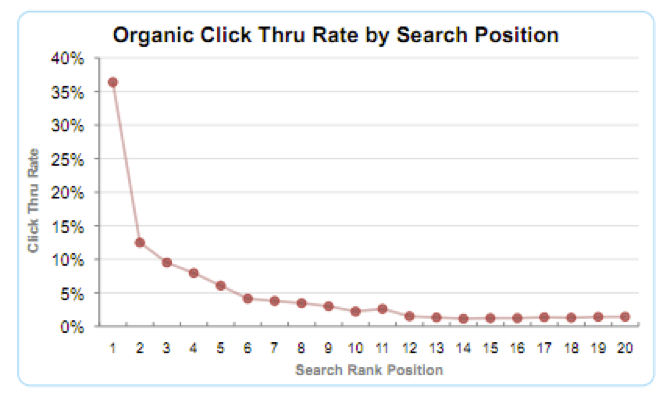
I personally use Moz and their domain authority (DA) metric to evaluate potential sites for syndication. Your goal is the first page, and more precisely, the first three positions, as the click-through rate drops below a mere eight after the 3d ranking (see the chart below).
Credit: SmartInsights
As such, in most cases, you are shooting for sites with a DA of 80 or higher.
For perspective, here are the DA ranks of several highly credible sites:
www.forbes.com — DA: 96
www.thenextweb.com—DA: 89
www.contently.com— DA: 71

Make sure you use effective CTAs

Another key to the success of syndicated SEO content is the quality of CTAs in the article. Since the content doesn’t reside on your site, you are limited to text CTAs, which are not the best type of plugs to catch attention.
But still, there are ways to achieve damn good click-through rates if you are doing it right. (For some reference, I managed to achieve a CTR of five percent with a CTA  on sites like Forbes. Please note that I’m not adding visits to related articles in this figure, which would pump it up twice.)
Now, let’s get back to the topic.
First, you have to understand that the majority of the audience will just glance through the article and spend no more than 10–30 seconds on it, according to multiple studies.
For those people, we want to include a bold CTA that visually stands out from the rest of the article. To that end, I use a CTA note at the bottom with a bolded subhead, a short paragraph about the offer followed by a sentence that entices to take action now.
Example:
FREE eBook: How to Build an Email list of 50,000+ Subscribers from Scratch
In this eBook, you’ll learn seven ways to drive traffic that converts to your brand new blog, five types of high-converting lead magnets and much more to build highly-targeted email lists of 50,000+ subscribers in a year. Claim your free copy today!
Some readers, however, will dive deeper into your article, for whom we need something more organic. To that end, I use one or several subtle contextual CTAs inline with the text. If the publication’s link policy allows me, I bold them.
Example:
…your lead magnets must contain five important elements if you want to achieve a high conversion rate. (I discuss them in depth in my free eBook, 5 lead Magnets that Convert. Download it here)
This kind of CTAs also serves another purpose. Since a CTA note is placed at the bottom, inline CTAs cover the audience that will not make it to the bottom—that’s going to be the bulk of the audience.
In addition to these two types of CTAs, I include links to related content on my sites.

Conclusion 

It’s a no-brainer to post SEO content on your site and leave it there if you have a high DA rank that can compete for keywords with a decent volume of searches in your domain.
But if you are just starting out or have a low-DA site that can’t beat the competition in this respect, this is a good workaround.
I know, getting featured on sites like Forbes is hard and it’s a completely different topic I won’t dive into now. But achieving a DA rank that is not even close to theirs takes way more time and resources.


Reference: https://thenextweb.com/contributors/2017/06/09/get-website-page-one-google-search-results/#.tnw_AXP2GCkQ

Thursday, June 8, 2017

37 Ways to Screen Job Candidates for Strategic SEO Thinking

Every SEO has their own favorite strategies to implement. When interviewing candidates for an SEO position, it’s important to know whether their strategies align with yours. While you’ll never be in agreement 100% of the time, the interview should give you a basic understanding of how the candidate’s strategies would align with your business.
Having an understanding of a candidate’s knowledge and experience is essential, and I have addressed those questions in previous posts. But knowledge and experience are only gateways to the most important thing: what the SEO will actually DO.
The following questions will help you better understand how your candidates stack up against each other and help you filter out those who are not right for your company.

1. What are three things you think are important to know before working on a new website?

The three things aren’t as important as why those things matter to them. This can tell you a great deal about how the candidate assesses a site’s needs and the responsibilities that lie ahead.

2. What is the first thing you do when you start optimizing a site?

The candidate will likely tell you that it depends on what they find out about the site, but don’t let them off the hook that easy. There are typically several things any SEO will want to do first. Encourage them to articulate what those are.

3. How do optimized pages and landing pages differ, and how do you employ these in your strategy?

Historically, landing pages are for PPC and optimized pages are for SEO. But really good SEOs think of every optimized page as a landing page. They should be able to outline what they do to treat optimized pages as such.

4. How do you go about optimizing a site with millions of pages?

You don’t need to have a million-page site for this question to be relevant. You want the candidate to provide some large-scale SEO tactics and strategies. Not every aspect of SEO needs to take a long time, and it’s these strategies that can help even small sites achieve results more quickly.

5. What do you do when your first attempt at SEO fails?

first attempt at SEO fails
First attempts at SEO are rarely successful, at least not immediately. And this is what you want to hear from a candidate: not only what they do when their first attempts fail, but whether they allow their efforts appropriate time (and assistance) to produce the desired results.

6. How do you future-proof websites against algorithm changes?

This uncovers the candidate’s overall philosophy. Every SEO will tell you that they do SEO for the long term, but this is where you can force them to discuss specific long-term tactics.

7. Other than content, what on-page elements do you optimize?

The candidate should talk about other important factors that may not be content — or even SEO — related. Today, things such as usability, visual appeal, and other factors are just as important to a site’s success as keyword and content optimization.

8. How do you deal with duplicate content?

Most SEOs will talk about canonical tags, but those are really just band-aids. Press candidates to discuss more permanent — and effective — solutions.

9. What are some things you never want to do as part of the optimization of a site?

This is an open-ended question, which can make it difficult to answer. The candidate might revert to the more typical answers that have been a problem with SEO since the beginning. However, a more experienced candidate might go into some uncharted or more controversial territory.

10. What plugins or tools do you use?

Tools were discussed in the experience-related questions, but this time you can either dive deeper into their list of tools or how particular tools are used specifically to assess a site and implement effective strategies.

11. How do you use competitor knowledge to succeed at SEO?

Competitor knowledge can be a goldmine of information, but not always. The candidate should be able to outline ways they use competitor data, how they integrate it into their strategy, and when they ignore what a competitor is doing.

12. A client is ready to roll out a new website. What do you do?

Let the candidate detail the process of launching a new website. What steps will they go through to make for a seamless launch? Listen for them to list things that should be done long before the launch date.

13. How do you approach keyword research?

Tools, process, keyword assessment — all of these are on the table for discussion. The candidate should have one or more processes they use to find and assess keywords for optimization.

14. How do you determine which keywords to optimize and where?

Jumping off the previous question, talk deeper about how keywords are selected for specific pages. Make sure the conversation addresses searcher intent and how it factors into page/keyword selection.

15. What is your process for optimizing keywords into a page?

keyword research approach
Encourage them to get as detailed as possible so you can determine if they attempt to integrate all the keyword phrases targeted or how they go about focusing on the overall topic.

16. How does keyword proximity factor into your optimization efforts?

You don’t need to specify proximity to what. Let the candidate do that. They should understand the various ways algorithms look at keywords in relation to other elements on the page. Let them do the talking to see if they know how to take advantage of this.

17. How do you assess the quality of inbound links?

The candidate can give you a tour of the tools and assessment they utilize to understand a site’s backlink profile. They should be able to articulate what constitutes a good or a bad link and their process for ensuring bad links don’t hurt the site.

18. How do you get backlinks?

Getting links is still important. The SEO may not want to perform actual link building, but they need to know how and be willing to if necessary. Let them take you through their process of researching, assessing, and obtaining high-quality links.

19. How have you dealt with link penalties?

Not every SEO will have experience with link penalties, but they should know what to do if they come across one. Have them discuss their process for getting out from under such a penalty.

20. Is it ever OK to pay for a link?

pay for links
Download Your Competitors SEO & PPC Campaigns
Get instant access to competitive insight that will help you increase your traffic and increase profit. SpyFu is free to try. No CC required.
If this wasn’t discussed above, get an understanding of the candidate’s beliefs regarding paying for links. This can include a healthy discussion on link-related search penalties.

21. What is your internal linking strategy?

The candidate should outline a course of action to massage internal links for search engine ranking exposure. Look for a measured approach. The candidate should be able to articulate the differences between good and bad internal linking strategies.

22. How do you use redirects?

Broken links may not harm your SEO, but that doesn’t mean redirects won’t help your efforts. Let the candidate discuss when, where, and how they use redirects, the benefits of doing so, and when redirects should not be employed.

23. How would you redirect a page?

The candidate should be familiar with the multiple ways to redirect pages and the different kinds of redirects. Have them discuss where and when each type should be used.

24. How would you optimize a site for local performance?

You aren’t looking for a discussion on local search algorithm signals but more of a list of things the candidate would do and why. Have them indicate a level of priority for each action.

25. How do you configure a site for mobile?

configure site for mobile
There are mobile sites, responsive sites, and AMP sites. The candidate should be familiar with the pros and cons of each of these and indicate their preference and why.

26. How would you go about assessing and improving site speed?

This can be a detailed and technical question. Ask the candidate for the broad strokes so you can determine their assessment skills and what they can (or can’t) do to improve a site’s speed.

27. How do you use nofollow tags?

Nofollows can be used strategically for good optimization, but not as once was believed. The candidate should outline a sensible strategy for using them, which should have nothing to do with channeling PageRank.

28. How do you use analytics to assist your SEO strategy?

Every SEO should have a basic understanding of analytics and the data needed to assess and improve their SEO strategy. Don’t just discuss metrics but how they use and compare those metrics.

29. What role does the TLD play in your SEO strategy?

TLD strategy
Search engines generally don’t give preference to one top-level domain (TLD) over another until you get into country specific TLDs for international SEO. However, some TLDs might help with branding and marketing. See what your candidate says about this.

30. How do you optimize a site that targets customers in multiple countries using multiple languages?

If you aren’t optimizing for an international audience, you can skip this question. However, it can’t hurt to get an understanding of the candidate’s knowledge and strategy. Discuss options for optimizing for various countries and multiple languages, how that would impact the existing site, and what the candidate sees as the best way forward.

31. What role do heading tags play in your SEO strategy?

Many believe heading tags have minimal impact on SEO, but “minimal” doesn’t mean “none.” Discuss how much effort the candidate will invest in optimizing headings, as well as the time versus reward factor. Get a sense of where the candidate prioritizes this over other efforts.

32. How do you use sitemaps in your SEO strategy?

The candidate should be able to discuss the two types of sitemaps, how each is used, and why. They should also be able to communicate when sitemaps are a bad idea and when multiple sitemaps are better than one.

33. How would you try to improve click-through rates?

Many SEOs think that their job stops at achieving rankings, but that’s not so. Not only do click-through rates impact rankings, it’s an important part of the business’s success. And that makes it the business of the SEO.
There are specific things SEOs can do to influence CTRs from SERPs. Find out what strategies the candidate might employ.

34. How would you try to improve bounce rates?

As with click-through rates, bounce rates impact not only rankings but the bottom line of the business. Bounces occur for many reasons, and the candidate should be able to articulate a good handful of them, but make sure they dial in on those that are specifically impacted by the work the SEO does.

35. How would you try to improve conversion rates?

improve conversion rates
While this may technically fall outside of the SEOs purview, it’s important to the company’s success, which makes it important to the SEO. They may not be conversion experts, but they should have some conversion improvement ideas.

36. How would you try to improve a site’s engagement?

This question will be the one the candidate is least likely to have in-depth knowledge in, but that makes it a great question to ask. It’s always good to have team members who can provide feedback in other areas based both on their own industry knowledge and as a general user. See what ideas they have and how much the candidate stumbles over this question, or not.

37. How do you employ microsites into your SEO strategy?

Microsites do have a place, but they are often more harmful to the main site optimization than they are helpful. The candidate should be able to explain how, when, and why to use microsites.

The Final Test

As the interviewer, you need to be confident that the candidate’s strategies are going to help and never harm the sites they are working on. Knowledge and experience questions should be asked first as they can be used to more easily weed out poorly qualified candidates. But every remaining candidate needs to pass the strategy test.


Reference:https://www.searchenginejournal.com/seo-job-interview-questions-strategy/200538/

Wednesday, June 7, 2017

8 DIY SEO Tips to Optimize Your Mobile Marketing

Mobile SEO is the single most important marketing factor for the typical local business.

8 DIY SEO Tips to Optimize Your Mobile Marketing


Mobile online marketing is now synonymous with online marketing. More users consistently use mobile devices today than connected ones. In late 2016, Google began testing a mobile-first index. When they rollout and begin using the index, search engines will look to the mobile version of your website before the desktop version to determine ranking.
Websites without a mobile version or with a poorly optimized mobile website will slip even further in search engine results pages (SERPs) as the rollout encompasses more sites. The good news is that some mobile SEO tasks are very easy to do yourself.
If your content performs inconsistently across mediums, you’re missing an audience engagement opportunity. Mobile SEO, much like traditional SEO, is about creating and tagging content in a way that makes it stand out online. Use this list of DIY mobile SEO tips to protect your brand from search engine penalties and maintain online visibility:

1. Create a Google My Business listing.

One of the most important listings businesses owners can create, Google My Business accounts are free and simple to set up. Fill out the information to the best of your ability, and include as many images of your business as possible. When people enter a search for your business online or via a Google app, they will likely see this information first. Make it count.
Related: How to Set Up 'Google My Business' for Your Small Business

2. Frequently review all directory listings.

Beyond the Google My Business account, mobile users may use other websites and applications to find your brand. Frequently review and update all listings for your business online. Update listings on Yelp, local websites, TripAdvisor, Facebook, Angie’s List, the Better Business Bureau and other popular business directories. These listings will ensure searchers reach the right information when they search for your name.
Related: 7 DIY SEO Tactics for Companies Not Ready to Hire a Consultant

3. Get social.

On mobile devices, social media sites drive a significant amount of traffic. Around 80% of social media users spend their social media time on mobile devices. If you want to maintain visibility with mobile users, prioritize your social media marketing strategy. Use platform-specific advertising, engage with users, and/or post prolifically to ensure your brand stands out.
Related: Is Amazon's 'Merch' the Next Big Thing?

4. Take advantage of plugins.

If your business uses WordPress or another platform, take advantage of the plugins designed to make your mobile site more user friendly. WordPress offers plugins to improve site speed, optimize images, and take care of other important mobile SEO tasks. WPtouch is a somewhat ubiquitous WordPress plugin that will create a Google-approved mobile-friendly version of your website. If you’re not currently using a professional to update and optimize your website, look into how plugins can help you maintain visibility online.
Related: 20 Crucial WordPress Plugins

5. Use keywords for content visibility.

Mobile users search differently than desktop users. Optimize for mobile keyword searches to keep your content in front of the right people. While you can purchase tools to find the right keywords for your content, you can find keyword comparisons by device in Google’s Search Analytics.
Related: 3 Tools to Uncover Your Competitor's Keywords

6. Optimize images.

To improve page loading times on mobile devices, optimize images for mobile users. If you don’t use a plugin to help with images, identify the ones that present a problem using a page speed tool and then compress or change the dimensions for faster loading times.
Related: 5 Ways to Optimize Your Ecommerce Campaigns

7. Prepare your content for mobile.

In addition to searching differently on a mobile device, many people digest content differently. Readable and scan-friendly content tends to work better on mobile devices, but testing is the only way to know for sure. Consider using a basic A/B test format to determine which types of mobile content perform better.
Related: So, What's the 'X-Factor' in the A/B Testing Formula? (Infographic)

8. Optimize for local searches.

You may not want to dive into detailed code optimizations that can boost search rankings, but you may want to consider a few basic activities. To optimize for local searches, include both the city and state in title tags, the URL, the H1 heading, and Meta description.
Mobile SEO will soon trump desktop SEO. Consider working with a professional or attempting a DIY head start today to ensure your site maintains visibility in mobile and desktop searches. A few simple tweaks can boost your digital presence and bring local customers to your door.

Reference: https://www.entrepreneur.com/article/295328

Tuesday, June 6, 2017

Why Unlimited Web Hosting Services are Good for SEO


Why Unlimited Web Hosting Services are Good for SEO
Personally I never thought web hosting services really had impact in any business. All it summed up to was more money for the host. If you share the same school of thought you’re probably right especially if you haven’t seen clouding services. On my side I’ll take my sentiments back. What experience has taught me is the truth. Web hosting for SEO and cloud based services is really important. In reality it has more benefits to the business than anyone would imagine. Here are some of the most factual benefits it provides.
It keeps your links checked. Dead links deny your website the juice it deserves. Additionally it leads to high bounce rates and minimal conversions. At the end of it this leads to losses. When you have a web host this is often minimized. The reason is simple. Part of the host’s job is to keep an eye on your links and to update them every time they die. This keeps your website very active. At the end of it all your website will have minimal or no dead links at all and that cool.
It’s good for optimization. Today many prospective buyers own a Smartphone, tablet, or a browser. The best websites should be able to provide all the prospective visitors with a smooth ride irrespective of their choice of gadget. Such optimization is crucial in case you want a smooth flow of business. Expert web hosting services often cover for this kind of integrate-able optimization.
It is extremely convenient. The best web hosting services just don’t end with a single service, no! Actually there are often a variety of services provided including content creating, website design, and many more. Having all these services under one host is extremely convenient. You don’t have to waste so much time looking for independent services, money hiring new employees to do the job, and energy that over works your limited staff. That’s why hosting for SEO is ideal.
It’s also very much targeted. Imagine this, having a single platform whose main intention is to rank you? What this means is that every service they provide is intended to give your top notch visibility. These services are therefore targeted and will include downsizing the number of HTTP requests, minimizing load time to Google standards, developing ideal CSS, and many more.
It cuts down overall costs. Web hosting can be a shared affair. If shared, you’ll share the overall costs too. This would mean cutting costs. Additionally have an independent server means hiring techs to service and maintain it, web hosts provide those services within their package. At the end of the day you don’t have to hire such services. In overall you will minimize your costs.
It offers vital backups. If your server crashes it’s an obvious disaster. When hosted you don’t lose everything as these services involve routine backups. These routine backups ensure that you get back everything that you had worked for. It is therefore more reliable than having a personal system.

Conclusion

There is no doubt that hosting for SEO is very beneficial. For startup it is an assured security path too. In addition to all these it is also very affordable and extremely viable for cutting costs.
Make sure you find the best services. These should be provided by highly experienced experts. The experts should be trained professionals with the knowledge of the most vital business needs.


Reference: https://thenextweb.com/contributors/2017/06/05/unlimited-web-hosting-services-good-seo/#.tnw_nQYlxwQo

Monday, June 5, 2017

How to Deal With Competitors Targeting Your Brand Terms

How to Deal With Competitors Targeting Your Brand Terms 
 
A little bit of healthy competition won’t hurt anyone, right?
Well, that’s not always true. When it comes to branded bidding wars on Google paid search, things can turn real nasty.
Imagine the scene. You wake up one morning, search for your company’s brand name in Google, and discover your competitor has stolen the number 1 position in paid search and is gobbling up a large percentage of your traffic.
This is no ordinary traffic either. This is highly valuable traffic — they’re your best potential (or existing) customers.
For most brands, this would cause instant chaos, especially if your brand terms are searched for in large volumes. So, what next? Surely if you report this PPC shark to Google, they will take immediate action and remove their listing, right?
Think again.
Google lifted the ban on bidding on competitors’ branded keywords way back in 2008, and since then it’s been completely acceptable to bid against your competitor’s brand, as long as you don’t mention their trademark name within your ad copy. It’s a bit of a gray area, but completely fair in Google’s eyes.
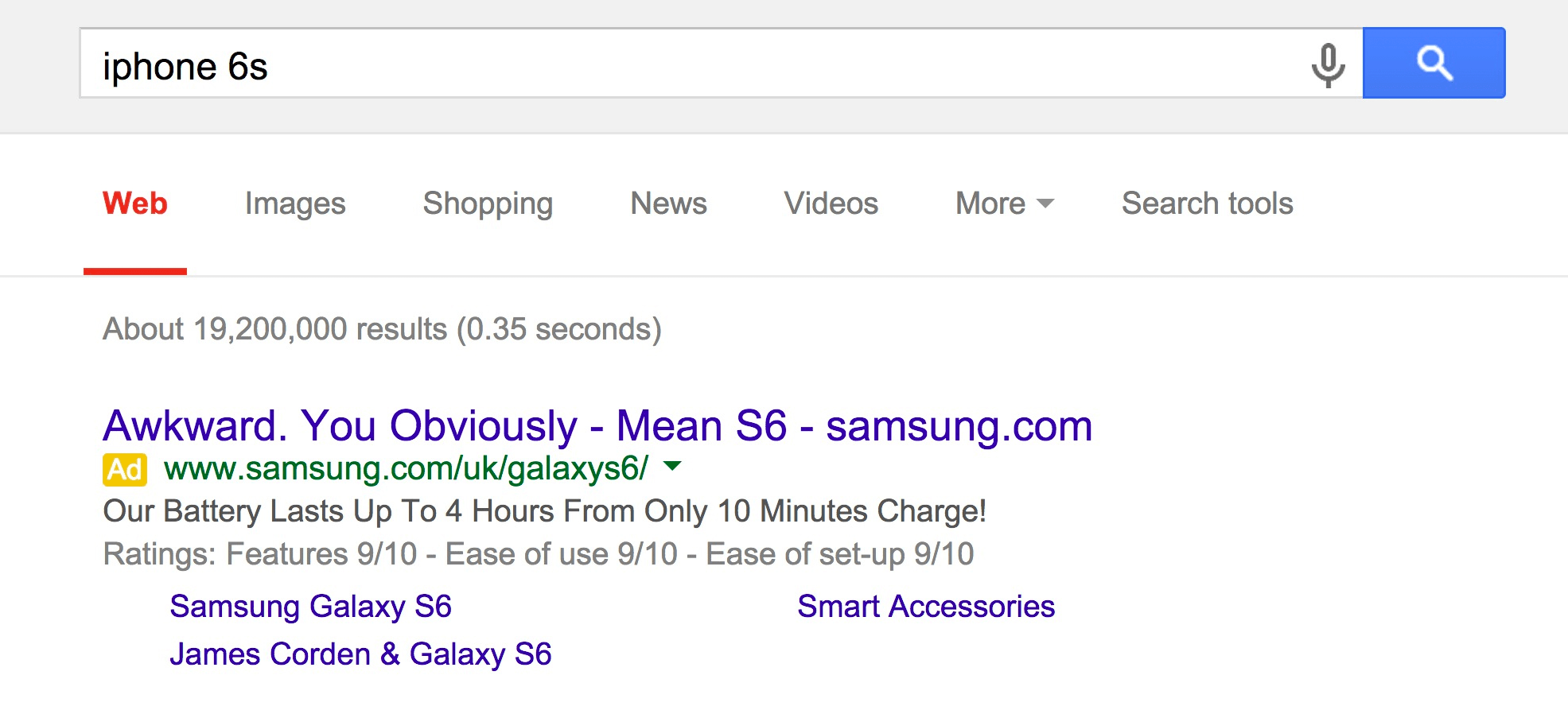
Many of us will already know about Samsung’s famous ‘Awkward. You obviously mean’ Google AdWords campaign targeting Apple’s precious iPhone 6s branded terms.
And I have to admit, this is creatively genius. It sparked plenty of media attention and the traffic was highly valuable. But I can guarantee Apple didn’t look at this in the same light.
Samsung targeting Apple on Google Adwords
In such a scenario, what would the best course of action?

Step 1: Acknowledge That Your Competitor May Never Take Down the Listing

It’s a tough blow to accept, but your competitor is under no legal obligation to remove their ads as long as they aren’t using your brand name in their ad text.
You have to come to terms with the fact that they will never remove the ads. The results may just be really powerful for them, leading to a high ROI/ROAS which could potentially be their most profitable campaign of all.
If they’re using your trademark name in their ad copy, however, this can be an infringement of Google’s trademark policy and therefore, you can submit a request to Google have their ads removed.

Step 2: Check Google Search Partners

Google isn’t the only search engine you should monitor for branded PPC. Its search partners could potentially be driving your competitors a lot of traffic.
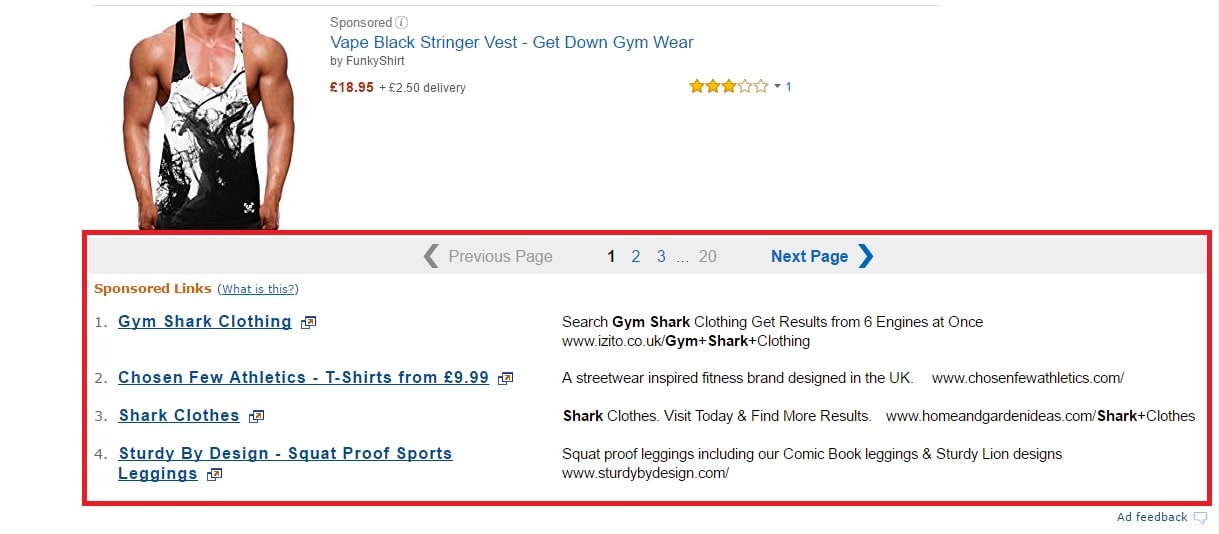
Unfortunately, Google doesn’t disclose a list of its search partners as its network is growing and they are subject to change at any point. That said, some of the most popular search partners are AOL.com, Ask.com, Dogpile.com, and Amazon.com.
Here’s an example of how the ads would appear on Amazon. For this example, I searched for “Gym Shark”, which is a popular sports and activewear brand based in the UK.
Gym Shark Google search ads
If you’d like to dig a bit further to uncover more search partners, a list can be found here, albeit they may not be 100% accurate.

Step 3: Check Bing and Its Search Partners

For sure, Google is by far the most dominant search engine, but don’t underestimate the power of Bing and its search partners to drive highly relevant, targeted traffic. This is not always true for unbranded search because CPCs tend to be lower, but conversion rates aren’t always as high as the Google search network.
For branded search, however, you may just uncover a heap of new customers you never knew existed.
If your competitors are going full throttle stealing your most prestigious web traffic, chances are they’re taking advantage of Bing and its search partners, too — particularly Yahoo. So keep your eyes peeled.
Download Your Competitors SEO & PPC Campaigns
Get instant access to competitive insight that will help you increase your traffic and increase profit. SpyFu is free to try. No CC required.

Step 4: Send Your Competitor a Polite Email Request

Think twice before going all out guns blazing, picking up the phone for a good old argument with your competitor.
Chances are, this will only make matters worse and they will be even more determined to conquer your branded search traffic. This could potentially have a serious impact on your bottom line, particularly if your USP is difficult to distinguish or your competitor has incentives in place to steal away your customers.
The best course of action is to send a polite email to your competitor asking them to take down the ad, in the interest of fair play. You can certainly send a word of warning later about your plans to take PPC revenge, but you should first give them an opportunity to remove the ads.
It could be the case that their PPC agency has set up these ads without permission or any prior notice. (This isn’t a good agency practice, but it’s been known to happen.)

Step 5: Set Up Your Own Branded Search Ads

Whoa, you mean to say you haven’t already done this?
Branded PPC ads are an absolute must. This is especially true if you wholesale products to other retailers.
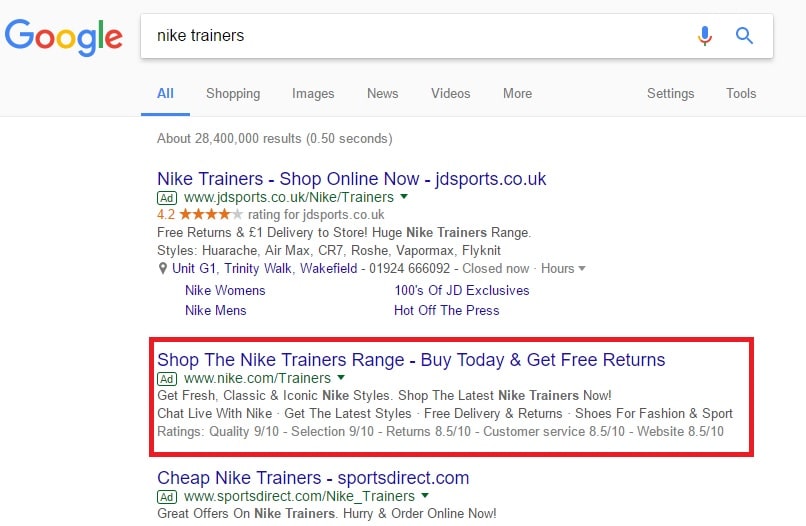
Take Nike, for example:
Nike Google Ads
But why would brands such as Nike bid on their own branded keywords if they’re already ranking highly organically?
Simply put, this allows brands to dominate the SERPs. Having multiple listings in Google (both paid and organic) can drastically improve your click-through rates and micro and macro conversions.
Unless there are numerous brands bidding against your brand name and thus increasing the bids, the CPCs are usually really cheap and you can maintain full control of your brand messaging.
Additionally, if you’re targeting your brand name as a broad or phrase match, you can check the search term reports to see what other terms people are associating with your brand.
Did I mention the cost-per-clicks are really cheap?
You should also consider targeting ‘top of page’ bid strategy to ensure your branded search ad is always at the top of the search results, capitalizing on the bulk of the traffic and knocking your competitors down. But this depends on their level of PPC knowledge and, ultimately, how much they’re willing to pay for placement positions.

Step 6: Consider Targeting Your Competitors’ Branded Keywords

As a last resort, but a tactic which can absolutely be worthwhile, is targeting your competitors’ precious branded terms with a new ad campaign. This may lure your competitor into taking their ads down as a mutual agreement to doing the same.
If their brand search volume is much lower than yours, however, this most likely won’t be the case as they will see more benefit from targeting your keywords.
Targeting your competitors brand terms as “revenge” can be considered as damage limitation, but it certainly can be a route worth taking if they’re reluctant to remove their ads.

Conclusion

Targeting your competitors branded terms can certainly be highly profitable, although it can lead to a serious marketing war which could be more damaging in the long-run. It’s important to weigh all the pros and cons before taking the plunge. Remember to do your research prior to taking this dark route.


Reference: https://www.searchenginejournal.com/ppc-branded-keyword-bidding-wars/200336/

Friday, June 2, 2017

The 7 Pieces of a Successful SEO Starter Kit


The 7 Pieces of a Successful SEO Starter Kit

so you're interested in search engine optimization (SEO), but like most newcomers, you're intimidated by the perceived complexity of the field. To be sure, there are hundreds of independent variables that collectively bear an impact on your site's rankings and search engine visibility.
Related: 6 Essential SEO Strategies to Incorporate in 2016
And, learning how to master all of them is a process that takes years of experience and practice.
However, you don't need a huge budget or years of experience to get started with SEO. Dominating the top rankings for general keywords related to your brand may be out of your reach, but even a slight investment in SEO can help your business earn more traffic and visibility.
To get started, you'll need these seven basic components of a starter SEO campaign:

1. A website with a good SEO plugin

First, you need a decent website, and if this one is your first effort, and/or you want to keep things simple, it's in your best interest to use a website builder like Wordpress. In fact, this and most other website builder tools are inexpensive and easy to use; and, importantly, they come automatically equipped to handle basic SEO fundamentals.
For example, they'll be coded in a way that's neat, clean and easy to crawl, and they'll be responsive, so you needn't worry about a separate strategy for mobile optimization. You may also want to consider a separate SEO plugin, which can help you with technical tasks like optimizing title tags and meta descriptions, and pinpointing the keyword density of your various pages.

2. A carefully chosen niche

Next, you'll want to define your niche and target a list of carefully chosen keywords. If you go too general, you'll end up competing with businesses that have a much bigger budget and a longer history of development. Instead, it's better to focus on a highly specific niche that's relevant only to your customers.
At that juncture, you'll need to conduct some keyword research. You don't need to get fancy here; just target a mix of basic "head" keywords and extended "long-tail" keywords, and aim for terms with high volume and low competition ratings.

3. An on-site overhaul.

Next, you'll need to optimize your site directly. It's true that your website builder will set you up with some fundamentals, but you'll still need to add your own content.
Organize your pages into categories and subcategories, including page titles that contain some of your target keywords. Make sure every page of your site contains at least several hundred words of helpful, well-written, relevant content; and optimize all your title tags and meta descriptions while you're at it.
Related: 5 SEO Techniques You're Doing All Wrong

4. A regular blog

I'd argue that the most important thing for a new SEO strategy to take off is a high-quality, regular content-marketing campaign. Aim to produce at least two new posts every week, covering topics that are relevant to your readers, and providing detailed, helpful information that your competitors haven't already covered.
Originality, practicality and aesthetic value all matter here, so spend some time refining your strategy and stick to your editorial calendar. You'll also want to include a blend of mediums, including images and videos, if you can.

5. An off-site publication schedule.

Aside from on-site optimization and content marketing, the most important element of your strategy is your link building campaign -- otherwise known as off-site optimization. The quality and quantity of links you have pointing to your domain determines your overall authority, which in turn determines where you rank for various search queries.
However, you can't just spam off-site links -- nor would you want to. Instead, focus on writing valuable content for external publishers, establishing your author profile and your expertise simultaneously. Usually, you'll earn at least one link back to your site, and over time, you'll develop your authority so you can rank higher.

6. Integrated social media

Contrary to popular belief, social media doesn't have a direct relationship with your search rankings. However, it can have an indirect bearing on the success of your SEO campaign. So, flesh out your profiles and regularly promote your latest content; you'll earn more shares and links to those blog posts, which can boost your search visibility.
Additionally, you'll earn more followers, which can become an additional stream of traffic to your site (and a good way to get your foot in the door with more publishers since it establishes your credibility).

7. A good reporting strategy

Finally, you'll need some way to measure your effectiveness (so you can determine what changes you need to make to your strategy). A good starter tool for this is Google Analytics, which will allow you to measure your "organic traffic" -- meaning the amount of traffic you're generating naturally through search engines. Ideally, this will grow over time.
Implementing these seven "starter kit" items won't let you tap your business's full online marketing potential, but they can and will get you started on the right path. With a decent infrastructure in place, including a baseline domain authority score, your subsequent investments will become even more valuable.


Reference: https://www.entrepreneur.com/article/294548